

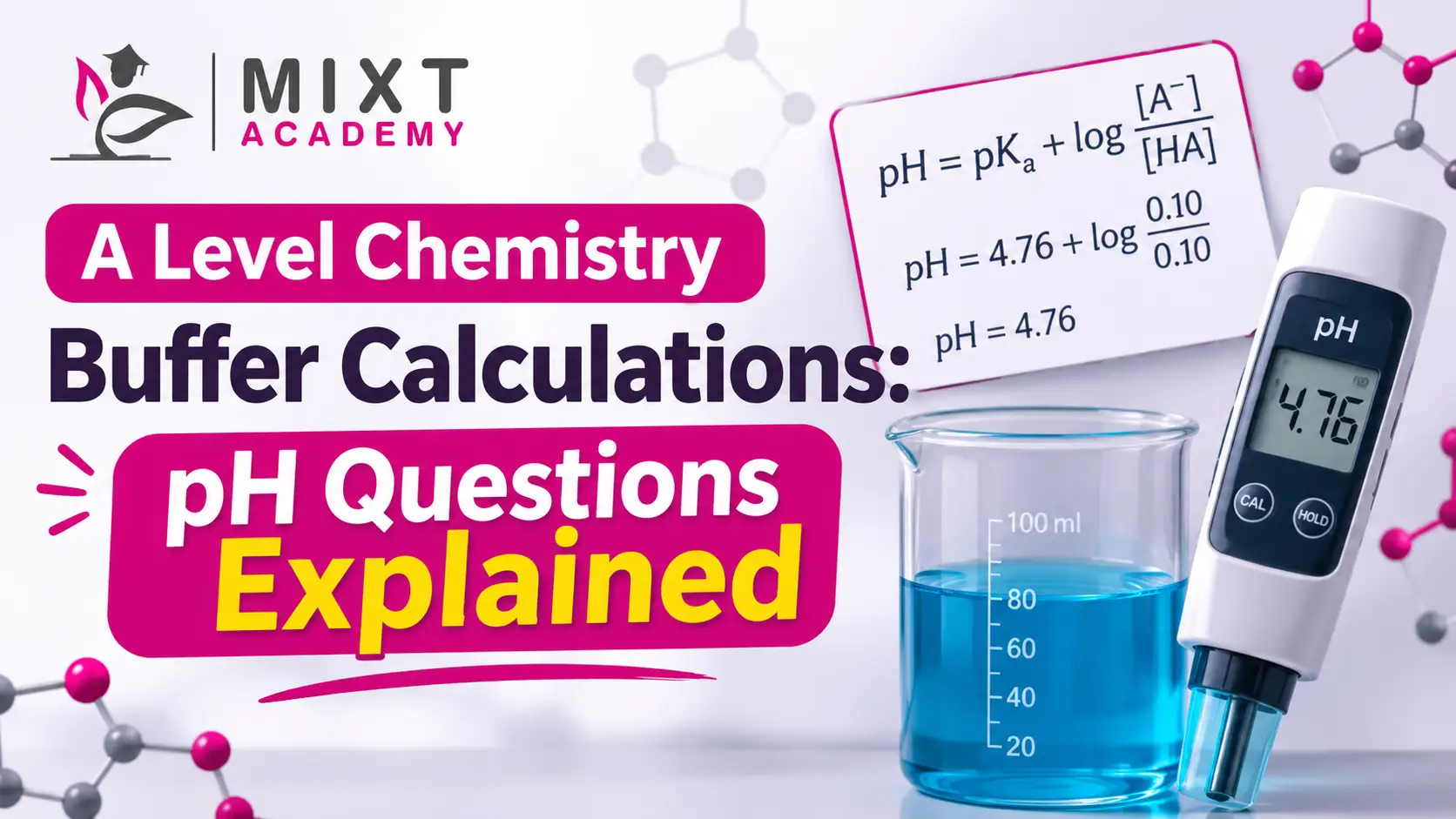
Whether you study AQA, OCR or Edexcel Chemistry, the same principles help you solve most acidic buffer questions. The key is knowing which quantities to calculate before applying the correct equation.
Mixt Academy helps students develop these calculation skills through structured explanations and exam-focused practice. This guide covers the essential formulas, worked examples and common mistakes to help you approach buffer pH questions with confidence.
What Is a Buffer Solution in A Level Chemistry
A buffer solution is defined as a system that minimises changes in pH when small amounts of strong acid (H+) or strong alkali (OH-) are added. Every buffer relies on a conjugate acid-base pair present in large, reservoir-like concentrations to mop up added ions.
| Buffer Type | Composition | Classic Exam Example |
|---|---|---|
| Acidic Buffer (pH < 7) | Weak acid + soluble salt of its conjugate base | Ethanoic acid + sodium ethanoate (CH₃COOH / CH₃COONa) |
| Basic Buffer (pH > 7) | Weak base + soluble salt of its conjugate acid | Ammonia + ammonium chloride (NH₃ / NH₄Cl) |
How an Acidic Buffer Resists pH Change
In an ethanoic acid / sodium ethanoate buffer, two equilibria exist simultaneously:
- Weak Acid (Partially Dissociated): CH₃COOH(aq) ⇌ CH₃COO¯(aq) + H⁺(aq)
- Soluble Salt (Fully Dissociated): CH₃COONa (aq) → CH₃COO⁻(aq) + Na⁺(aq)
This creates a large reservoir of both CH₃COOH and CH₃COO⁻:
- When strong acid (H⁺) is added, the conjugate base reservoir removes it (CH₃COO⁻ + H⁺ → CH₃COOH). The equilibrium shifts left, keeping [H+] nearly constant.
- When strong alkali (OH⁻) is added, the weak acid reservoir neutralises it (CH₃COOH + OH⁻ → CH₃COO⁻ + H₂O). The equilibrium shifts right to replace lost H+ ions.
The Acid Dissociation Constant (Ka) and Buffer Formula
For any weak acid HA dissociating in water: HA ⇌ H⁺ + A⁻
The acid dissociation constant is Ka = [H⁺] × [A⁻] / [HA]
Rearranging to calculate hydrogen ion concentration gives the core buffer equation: [H⁺] = Ka × ([HA] / [A⁻])
Once you find [H⁺], convert it into pH: pH = −log₁₀[H⁺]
The Two Standard Exam Assumptions
Examiners frequently award marks for stating the assumptions behind this formula.
- Minimal acid dissociation
The weak acid dissociates so slightly that its equilibrium concentration is approximately equal to its initial concentration.
[HA] at equilibrium ≈ [HA] initially - Complete salt dissociation
All conjugate base ions come from the fully dissociated salt.
[A⁻] at equilibrium ≈ [Salt] initially
Henderson-Hasselbalch Equation Steps
Taking the negative logarithm (−log₁₀) of the Ka expression produces the Henderson-Hasselbalch equation:
pH = pKa + log₁₀([A⁻] / [HA])
Where:
- pKa = −log₁₀(Ka)
- Ka = 10⁻ᵖᴷᵃ
UK Exam Board Note (AQA, OCR and Edexcel)
The primary buffer calculation method uses the following expression:
[H⁺] = Ka × ([HA] / [A⁻])
You can also use the Henderson-Hasselbalch equation as an alternative calculation method. Choose the method that makes your working clearer and reduces the risk of algebra errors.
Watch the Fraction: In the Ka formula, the weak acid [HA] is on top. In the Henderson-Hasselbalch equation, the conjugate base [A⁻] is on top.
Scenario A: Direct Mixing Buffer Calculation (Step by Step)
When to Use This Method: When a weak acid solution is mixed directly with a solution of its soluble salt.
Worked Example 1: Ethanoic Acid and Sodium Ethanoate
Question: Calculate the pH of a buffer formed by mixing:
- 25.0 cm³ of 0.200 mol dm⁻³ ethanoic acid (CH₃COOH).
- 35.0 cm³ of 0.150 mol dm⁻³ sodium ethanoate (CH₃COONa).
Given: Ka of ethanoic acid = 1.74 × 10⁻⁵ mol dm⁻³.
Step 1: Calculate the Moles of Weak Acid (HA)
Moles = Concentration × Volume in dm³
Moles of CH₃COOH:
= 0.200 × (25.0 / 1000)
= 0.00500 mol
Step 2: Calculate the Moles of Conjugate Base (A⁻)
Moles of CH₃COO⁻:
= 0.150 × (35.0 / 1000)
= 0.00525 mol
Step 3: Substitute the Moles Into the Buffer Formula
Because both components share the same final solution volume, the total volume cancels out in the concentration ratio. You can use the mole amounts directly.
[H⁺] = 1.74 × 10⁻⁵ × (0.00500 / 0.00525)
[H⁺] = 1.657 × 10⁻⁵ mol dm⁻³
Step 4: Calculate the pH
pH = −log₁₀(1.657 × 10⁻⁵)
Final Answer: pH = 4.78
Scenario B: Buffer Calculations After Partial Neutralisation
When To Use This Method: When a strong base, such as NaOH, is added to an excess of a weak acid. The reaction produces the conjugate base needed to form a buffer.
Worked Example 2: Propanoic Acid and Sodium Hydroxide
Question: Calculate the pH when 50.0 cm³ of 0.500 mol dm⁻³ propanoic acid (CH₃CH₂COOH) reacts with 20.0 cm³ of 0.400 mol dm⁻³ sodium hydroxide (NaOH).
Given: Ka = 1.35 × 10⁻⁵ mol dm⁻³.
Step 1: Calculate the Initial Moles of Both Reactants
Initial moles of propanoic acid:
= 0.500 × (50.0 / 1000)
= 0.0250 mol
Initial moles of OH⁻:
= 0.400 × (20.0 / 1000)
= 0.00800 mol
Step 2: Use a BCA (Before–Change–After) Mole Table
Balanced Equation: CH₃CH₂COOH + OH⁻ → CH₃CH₂COO⁻ + H₂O
| Stage | CH₃CH₂COOH (Acid) | OH⁻ (Strong Base) | CH₃CH₂COO⁻ (Conjugate Base) |
|---|---|---|---|
| Before | 0.0250 mol | 0.00800 mol | 0 mol |
| Change | −0.00800 mol | −0.00800 mol | +0.00800 mol |
| After | 0.0170 mol | 0 mol | 0.00800 mol |
Step 3: Calculate [H⁺] Using the Remaining Moles
[H⁺] = Ka × ([HA] / [A⁻])
[H⁺] = 1.35 × 10⁻⁵ × (0.0170 / 0.00800)
[H⁺] = 2.869 × 10⁻⁵ mol dm⁻³
Step 4: Calculate the pH
pH = −log₁₀(2.869 × 10⁻⁵)
Final Answer: pH = 4.54
Scenario C: Calculating pH After Adding Strong Acid or Alkali
When to use this method: When an examination question gives you an existing buffer and asks you to calculate its new pH after adding a small amount of HCl or NaOH.
Start with the buffer from Example 2:
- Propanoic acid = 0.0170 mol.
- Propanoate ions = 0.00800 mol.
- Initial pH = 4.54.
Case 1: Adding 0.00100 mol of Strong Acid (HCl)
The added H⁺ reacts with the conjugate base.
CH₃CH₂COO⁻ + H⁺ → CH₃CH₂COOH
Calculate the New Mole Amounts:
- New conjugate base moles: = 0.00800 − 0.00100 = 0.00700 mol
- New weak acid moles: = 0.0170 + 0.00100 = 0.0180 mol
Calculate hydrogen ion concentration:
[H⁺] = 1.35 × 10⁻⁵ × (0.0180 / 0.00700)
[H⁺] = 3.471 × 10⁻⁵ mol dm⁻³
Calculate the new pH:
pH = −log₁₀(3.471 × 10⁻⁵)
New pH = 4.46
The pH decreases by approximately 0.08 units.
Case 2: Adding 0.00100 mol of Strong Alkali (NaOH)
The added OH⁻ reacts with the weak acid.
CH₃CH₂COOH + OH⁻ → CH₃CH₂COO⁻ + H₂O
Calculate the New Mole Amounts:
- New weak acid moles: = 0.0170 − 0.00100 = 0.0160 mol
- New conjugate base moles: = 0.00800 + 0.00100 = 0.00900 mol
Calculate hydrogen ion concentration:
[H⁺] = 1.35 × 10⁻⁵ × (0.0160 / 0.00900)
[H⁺] = 2.40 × 10⁻⁵ mol dm⁻³
Calculate the new pH:
pH = −log₁₀(2.40 × 10⁻⁵)
New pH = 4.62
The pH increases by approximately 0.08 units.
Get Help With Multi-Step Buffer Calculations
Struggling with multi-step equilibrium calculations? Mixt Academy offers one-to-one online A Level Chemistry tutoring to help you work through past paper buffer questions step by step. Learn how to manage mole calculations, apply equilibrium expressions and tackle common examination questions. Book your personalised Online Chemistry tuition with an examiner-level instructor.
Basic Buffer Calculations (Kb and pKa)
For basic buffers such as ammonia and ammonium chloride (NH₃ / NH₄Cl), you have two calculation methods, depending on which constant the question provides.
Route 1: Using Kb and Kw at 298 K
Calculate hydroxide ion concentration: [OH⁻] = Kb × ([NH₃] / [NH₄⁺])
Convert [OH⁻] into [H⁺] using the ionic product of water:
- Kw = [H⁺] × [OH⁻]
- Kw = 1.00 × 10⁻¹⁴ mol² dm⁻⁶
Therefore: [H⁺] = Kw / [OH⁻]
Then: pH = −log₁₀[H⁺]
Alternatively, Calculate pOH First:
- pOH = −log₁₀[OH⁻]
- pH = 14.00 − pOH
Route 2: Using Ka of the Conjugate Acid (NH₄⁺)
You can treat NH₄⁺ as the weak acid (HA) and NH₃ as its conjugate base (A⁻).
The equation becomes: [H⁺] = Ka(NH₄⁺) × ([NH₄⁺] / [NH₃])
This lets you calculate the hydrogen ion concentration directly when the question provides Ka for ammonium ions.
8. Half-Equivalence Point and Buffer Capacity
The Half-Equivalence Point (pH = pKa)
During a weak acid–strong base titration, the half-equivalence point occurs when exactly half of the original weak acid has been neutralised.
At This Stage: [HA] = [A⁻]
Substituting Into the Buffer Equation: [H⁺] = Ka × 1
Therefore: [H⁺] = Ka
Taking the Negative Logarithm: pH = pKa
Exam Shortcut: Read the pH at half the equivalence volume on a weak acid titration curve to find pKa.
Buffer Capacity and Blood pH
Buffer capacity describes how much acid or alkali a buffer can absorb before its pH changes significantly.
- Best Buffering Range: Buffering is most effective when: [HA] ≈ [A⁻]
This occurs within approximately ±1 pH unit of the pKa, with higher overall concentrations providing greater buffer capacity. - Dilution Rule: Adding distilled water reduces buffer capacity but does not significantly change the pH. Both [HA] and [A⁻] decrease by the same factor, so their ratio remains unchanged.
- Biological Application: Human blood maintains a pH of approximately 7.35–7.45 using the carbonic acid and hydrogencarbonate buffer system.
H₂CO₃ ⇌ H⁺ + HCO₃⁻
Buffer Calculation Cheat Sheet
Use this table to identify the correct method for different examination questions.
| Question Scenario | Step 1: Mole Setup | Step 2: Formula to Apply |
|---|---|---|
| Direct Mixing (weak acid + salt) | Calculate n(HA) and n(A⁻) separately. | [H⁺] = Ka × n(HA) / n(A⁻) |
| Partial Neutralisation (excess acid + base) | n(HA) remaining = n(HA) initial − n(OH⁻) reacted. n(A⁻) formed = n(OH⁻) reacted. | [H⁺] = Ka × n(HA remaining) / n(A⁻ formed) |
| Adding Strong Acid (+H⁺) | New n(HA) = n(HA) + n(H⁺). New n(A⁻) = n(A⁻) − n(H⁺). | [H⁺] = Ka × n(HA new) / n(A⁻ new) |
| Adding Strong Alkali (+OH⁻) | New n(HA) = n(HA) − n(OH⁻). New n(A⁻) = n(A⁻) + n(OH⁻). | [H⁺] = Ka × n(HA new) / n(A⁻ new) |
Six Common Mistakes in Buffer Calculations
- Flipping the ratio: Using [A⁻] / [HA] in the Ka expression instead of [HA] / [A⁻].
Correct formula: [H⁺] = Ka × [HA] / [A⁻].
Remember that adding acid must decrease pH, while adding alkali must increase pH. - Forgetting to convert cm³ into dm³: Always divide the volume by 1,000 before multiplying it by concentration.
- Missing the 1:2 stoichiometry of Ba(OH)₂ or Ca(OH)₂: One mole of Ba(OH)₂ releases two moles of OH⁻ ions. Multiply the moles of the base by two before subtracting the reacting hydroxide ions from the weak acid.
- Using initial acid moles instead of remaining moles: During partial neutralisation, subtract the reacted acid before calculating hydrogen ion concentration.
- Confusing Ka and pKa, remember:
Ka = 10⁻ᵖᴷᵃ
pKa = −log₁₀(Ka) - Rounding too early: Keep full calculator precision during intermediate steps. Round the final pH to two decimal places unless the question specifies otherwise.
A Level Chemistry Buffer Exam Questions With Answers
Test yourself with these practice questions before checking the solutions.
Practice Question 1: Direct Buffer Calculation
A buffer contains:
- 0.20 mol dm⁻³ ethanoic acid.
- 0.30 mol dm⁻³ sodium ethanoate.
Ka = 1.74 × 10⁻⁵ mol dm⁻³.
Calculate its pH.
Solution:
[H⁺] = 1.74 × 10⁻⁵ × (0.20 / 0.30)
[H⁺] = 1.16 × 10⁻⁵ mol dm⁻³
pH = −log₁₀(1.16 × 10⁻⁵)
Answer: pH = 4.94
Practice Question 2: Alkali Addition
A buffer contains:
- 0.010 mol of a weak acid.
- 0.006 mol of its conjugate base.
pKa = 4.85.
You add 0.002 mol of NaOH. Calculate the new pH.
Solution:
Remaining weak acid: = 0.010 − 0.002 = 0.008 mol
New conjugate base: = 0.006 + 0.002 = 0.008 mol
Since the moles of weak acid and conjugate base are equal: pH = pKa
Answer: pH = 4.85
Practice Question 3: Diprotic Base Calculation
25.0 cm³ of 0.100 mol dm⁻³ Ba(OH)₂ is added to 50.0 cm³ of 0.250 mol dm⁻³ methanoic acid. Given: Ka = 1.60 × 10⁻⁴ mol dm⁻³. Calculate the resulting pH.
Solution:
Step 1: Calculate the moles of methanoic acid.
= 0.250 × 0.0500
= 0.0125 mol
Step 2: Calculate the moles of Ba(OH)₂.
= 0.100 × 0.0250
= 0.00250 mol
Each mole of Ba(OH)₂ produces two moles of OH⁻.
Moles of OH⁻: = 2 × 0.00250 = 0.00500 mol
Step 3: Calculate the remaining acid.
= 0.0125 − 0.00500
= 0.00750 mol
Step 4: Calculate the methanoate ions formed.
= 0.00500 mol
Step 5: Calculate the hydrogen ion concentration.
[H⁺] = 1.60 × 10⁻⁴ × (0.00750 / 0.00500)
[H⁺] = 2.40 × 10⁻⁴ mol dm⁻³
Step 6: Calculate pH.
pH = −log₁₀(2.40 × 10⁻⁴)
Answer: pH = 3.62
Mark Scheme Self-Check List
Before moving on from a buffer calculation, check that your working includes:
- A balanced equation for any neutralisation reaction.
- Initial moles of acid and base, including cm³ to dm³ conversions.
- Final mole amounts of both HA and A⁻.
- The correct Ka or Henderson-Hasselbalch expression.
- The final pH rounded to two decimal places, unless instructed otherwise.
Ready to Master A Level Chemistry Calculations?
Don’t let equilibrium and pH questions cost you marks in your A Level Chemistry examinations. Mixt Academy’s online tutors break down complex topics into simple, repeatable examination strategies tailored to your syllabus. Book your one-to-one online A Level tutoring with Mixt Academy.