
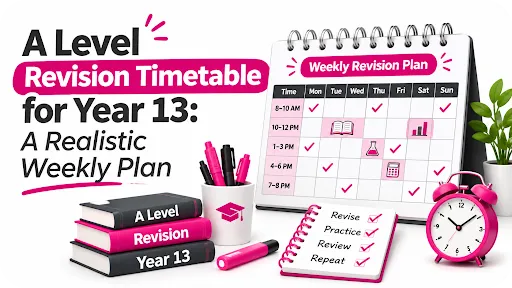
A practical Year 13 timetable starts with your exam dates and a step-by-step plan. Try to study around 8 hours a week in autumn, 11 in spring, and 23 during the Easter holiday and study leave. Switch between your three subjects, finish each session by reviewing what you learned, do a timed past-paper section every week, keep one evening free and get enough sleep.
In Year 13, revision turns from a vague idea into something you need to fit into your schedule. You still have lessons, plus university applications and mocks to think about, and the A-level exams are coming up faster than you might expect. This guide gives you a plan you can actually use: it covers the key 2027 dates. Moreover, it suggests how many hours to study in each phase, shows three example weeks with the time added up, gives a daily session template, offers subject-specific tips, and explains what to do around mocks and between papers. It’s made for students taking three A Levels, but you can adjust it for more or fewer subjects.
Why Most Timetables Fail by February
A timetable doesn’t work if it expects you to fit more into a week than you can. Common problems are colour-coded grids that forget about lessons, work, and sleep; giving every subject the same amount of time even if you find some harder than others; and not leaving space for things you didn’t plan. This usually leads to giving up on the plan within two weeks, feeling guilty, and then cramming at the last minute.
The solution isn’t just discipline. Instead, start with the hours you actually have, focus on your weakest topics first, and update your plan every week. The best way to make revision manageable is to follow a simple routine that gives each subject regular attention and leaves room to adjust your priorities.
Your Year 13 Calendar: The Dates That Shape the Plan
Start planning by working backwards from the fixed dates. These dates are set by the Joint Council for Qualifications (JCQ) for June 2027 and by UCAS.
| Date | What happens |
|---|---|
| Wednesday 13 January 2027, 18:00 | UCAS equal consideration deadline for most undergraduate courses (those with a 15 October deadline excluded) |
| Sunday 28 March 2027 | Easter Sunday, so Easter holidays fall around late March and April (school dates vary). |
| Monday 10 May 2027 | First day of the written exam series on the common timetable |
| Saturday 15 May 2027 | Deadline for exam centres to submit centre-assessed marks (not a student revision deadline). |
| Tuesday 22 June 2027 | Final A Level paper on the common timetable |
| Wednesday 23 June 2027 | This is a reserve day in case an exam needs to be rescheduled due to a national disruption. |
| Thursday 12 August 2027 | A Level results day |
Important: These dates provide an overview of the 2027 A-Level examination period. Your actual exam dates will depend on your subjects and exam board, so check the timetable provided by your school or college. The centre-assessed marks deadline is an administrative date for exam centres, not a deadline for students to complete their revision.
Your exams will take place between 10 May and 22 June, so check your exam board’s timetable (AQA, Pearson Edexcel and OCR all publish them) as soon as you can. Starting from mid-November 2026, you have about 26 weeks until the first possible paper and 32 weeks until the last. This gives you enough time to prepare well, but not enough to lose focus.
Your school decides when mocks happen, not the exam board, so make sure to add those dates to your calendar when you get them. Most A Levels in England follow a linear structure, meaning that written examinations take place at the end of the course. However, some subjects also include non-exam assessments, such as coursework or performances, so check your exam board’s specification when planning your revision. That’s why the plan below helps you build up to them step by step.
How Many Hours Is Realistic?
There isn’t an official number of revision hours. Different guides give different advice. For example, Save My Exams suggests 6 to 8 hours per subject each week in the autumn of Year 13, which is a lot if you have three subjects. Others recommend much less. The best answer is to do as much as you can manage without burning out, taking into account your lessons, work, and other activities. This plan counts the total hours you spend outside lessons, across all three subjects.
The hours below are suggested independent-revision targets across all three A-Level subjects, outside timetabled lessons. They are a starting point rather than a fixed requirement. Your workload, homework, coursework, mock results and confidence in each subject should determine how much additional revision you need.
| Phase | Typical dates | Weekly revision hours | Main focus |
|---|---|---|---|
| 1. Foundations | Mid-November to mid-December | About 8 | Topic audit, repair red topics, start the spaced cycle |
| 2. Christmas break | Late December to early January | About 8 to 10, with full rest days | Consolidate, prepare for mocks. |
| 3. Mocks and rebuild | January to February (school dates vary) | About 11 | Mock preparation, then a post-mock rebuild |
| 4. Spring build | February to Easter | About 11 to 13 | Topic cycles plus weekly timed past-paper sections |
| 5. Easter holiday | Around late March to mid-April | About 23 | Intensive revision and full past papers |
| 6. Run-up and study leave | Mid-April to the first paper | About 20 to 25 | Past papers, weak topics, recall |
| 7. Exam season | 10 May to 22 June | Planned paper by paper | Targeted recall, rest, sleep |
Use these as a starting point. If you have a part-time job or a busy sports schedule, plan based on the hours you actually have. If you’re taking four subjects, add about a third more time.
Read our blog: A Levels Explained for Parents
Build Your Timetable in Five Steps
Step 1: Audit at the topic level (about an hour, once)
Write down every topic in each specification and rate each one from 1 (can’t explain it) to 5 (can answer exam questions without notes). Use your mock results, marked homework, and teacher feedback to help. Colour code them: red for 1 or 2, amber for 3, and green for 4 or 5.
Step 2: Count your real hours.
Block out lessons, travel, work, sport, family time, and sleep on a blank weekly schedule. The time left is your real revision time. Plan to use about three-quarters of this, so you have room for unexpected events.
Step 3: Weight by weakness
Spend most of your time on red topics, less on amber, and just short review sessions on green. As a guide, put about half your time into red topics, a third into amber, and the rest into green. Every two or three weeks, rate your topics again and update your plan based on the new colours.
Step 4: Schedule each topic on a spaced cycle.
Set up a simple repeating cycle for your topics. This way, you won’t learn something once and then forget it.
| Day | Activity | Time |
|---|---|---|
| Day 1 | Learn or repair the topic. | 45 to 60 minutes |
| Day 2 | Closed-book recall of what you learned | 20 minutes |
| Day 4 | Short review using exam questions | 15 to 20 minutes |
| Day 7 | Test the topic with timed questions. | 20 to 30 minutes |
| Day 21 | Re-test | 20 minutes |
Step 5: The Sunday rebuild (20 minutes)
Every Sunday, check off what you completed, update the rating for any topic that changed, and plan your sessions for the next week. Only move missed sessions to the next week if they are red topics, and drop green-topic sessions first. Don’t try to catch up by doing extra sessions in one day.
Three Sample Weekly Timetables
These sample weeks use three subjects, labelled A, B, and C. Replace them with your own subjects, and track your study time accurately.
Sample week 1: Autumn foundations (about 8 hours)
| Day | Session | Minutes |
|---|---|---|
| Monday | Subject A: repair one red topic | 60 |
| Tuesday | Subject B: repair one red topic | 60 |
| Wednesday | Subject C: repair one red topic | 60 |
| Thursday | Mixed recall (30) and mistake log (30) | 60 |
| Friday | Free evening | 0 |
| Saturday | Timed past-paper section (60), marking and mistake log (30), topic block (60) | 150 |
| Sunday | Recall (30), Sunday rebuild (20), flashcards (30) | 80 |
| Total | 470 minutes, about 7 hours 50 minutes |
Sample week 2: Spring build (about 11 hours)
| Day | Session | Minutes |
|---|---|---|
| Monday | Subject A: topic (60) and questions (30) | 90 |
| Tuesday | Subject B: topic (60) and questions (30) | 90 |
| Wednesday | Subject C: topic (60) and questions (30) | 90 |
| Thursday | Mixed recall (30), mistake log (30), weakest-topic repair (30) | 90 |
| Friday | Light flashcard recall | 45 |
| Saturday | Timed paper section (90), marking (45), topic block (45) | 180 |
| Sunday | Recall (45), Sunday rebuild (20), light review (25) | 90 |
| Total | 675 minutes, 11 hours 15 minutes |
Sample week 3: Easter holiday and study leave (about 23 hours)
| Day | Session | Minutes |
|---|---|---|
| Monday to Friday | Session 1: hardest topics (75), Session 2: timed questions or paper section (75), Session 3: recall and mistake log (75) | 225 each day, 1,125 in total |
| Saturday | One full timed paper (120) and marking (60) | 180 |
| Sunday | Recall and Sunday rebuild | 90 |
| Total | 1,395 minutes, 23 hours 15 minutes |
Plan your three sessions throughout the day and make sure to take real breaks. Try to keep Sunday afternoon or evening free. Focusing for about four hours a day is more realistic than aiming for six to eight, since unfocused hours don’t help much.
Structure Every Session the Same Way
Having a routine for each session means you don’t have to decide what to do next.
| Step | Time in a 60-minute session | What to do |
|---|---|---|
| 1. Warm-up recall | 5 minutes | Write what you remember from the last session on this topic. |
| 2. Learn or repair | 25 minutes | Work through the topic using notes, a textbook or a worked example. |
| 3. Questions | 20 minutes | Answer exam-style questions without notes. |
| 4. Mark and log | 10 minutes | Mark strictly, then write each error in your mistake log. |
Set a timer and make sure to take a real five-minute break between study sessions. Put your phone somewhere you can’t easily reach it.
Choose Revision Methods That Work
A well-known review by Dunlosky and his team found that practice testing and spreading out your study sessions work best. Mixing up topics, asking yourself questions, and explaining ideas to yourself helps too. Just rereading or highlighting was found to be less effective.
| Technique | Rating | Where it fits in your timetable |
|---|---|---|
| Practice testing | High | Step 3 of every session, plus weekly timed papers |
| Distributed practice | High | The spaced cycle in Step 4 |
| Interleaved practice | Moderate | Mixed recall on Thursdays and Sundays |
| Elaborative interrogation | Moderate | Ask, “Why does this work?” while repairing a topic. |
| Self-explanation | Moderate | Explain a worked solution aloud. |
| Rereading and highlighting | Low | Use only to prepare for testing. |
Research also shows why cramming does not work. It is better to spread your study hours over several weeks than to squeeze them into just a few days.
Adjust the Plan for Your Subjects
Each subject needs its own type of practice, so avoid using the same study session for every topic.
| Subject type | What to prioritise | Typical session |
|---|---|---|
| Maths and sciences | Problem practice, calculations, required practicals and error analysis | 30 to 45 minutes of questions per topic, repeated across the week |
| Essay subjects (English, history, politics) | Essay planning, evidence banks and mark-scheme levels | One planned essay or paragraph per session, with a full essay each week |
| Languages | Vocabulary, grammar, listening and speaking practice | Short daily sessions, with weekly timed writing |
| Subjects with coursework | Protect a fixed slot for non-exam work. | Finish it well ahead of the centre deadline in May. |
Try to study essay subjects when you feel most alert, and tackle calculation subjects in shorter, repeated sessions. If you have an extended project, set aside a regular weekly slot for it, and once it’s done, use that time for your A Levels. If you need extra support with a particular a-level subject, explore our online maths tutors, biology tutors, chemistry tutors and physics tutors. Students studying essay-based subjects can also explore our English tutors and history tutors in UK.
Mock Exams: Prepare, Sit and Rebuild
Mocks are the best way to see where you lose marks. Approach them in three steps.
- Before: About two weeks before your mocks, focus most of your study sessions on timed questions and past papers that cover the topics for the mocks.
- During: Take your mocks under real exam conditions. After each paper, note down which questions you found most difficult.
- After: Take a week to review every mark you lost. Sort your mistakes into categories like knowledge gaps, application errors, calculation mistakes, command-word issues, and careless slips. Update your topic ratings and plan the next four weeks based on what you found.
Mock results can affect your predicted grades, but each school has its own policy. Ask your teacher how your results will be used.
Planning Between Papers in the Exam Season
Once exams begin, usually from 10 May at the earliest, shift your study plan from covering all topics to focusing on specific ones.
- Use your personal exam timetable and keep track of each paper. Start with the subjects that need the most work.
- The day before an exam, limit yourself to two short study sessions. Review key points and try a few exam questions on your weakest topics.
- Set a clear time to stop studying in the evening, have a good meal, and get to bed on time.
- If you have two exams close together, use the time between them to rest and review, rather than trying to learn new material.
- After each exam, avoid overthinking it. Move on and focus on preparing for your next subject.
Sleep, Rest and Wellbeing
The NHS recommends that most teenagers get 8 to 10 hours of sleep each night. Try to keep regular bedtimes and wake-up times, even on weekends. Stop using screens about an hour before bed, and avoid caffeine and sugary drinks later in the day. Good sleep supports concentration, learning and memory, making it an important part of an effective revision routine.
Make sure to have one completely free evening each week and take at least one longer break every month. If you find you are sleeping poorly, avoiding revision, or losing interest in things you usually enjoy, talk to a parent, teacher, or your school’s pastoral team as soon as possible.
Common Timetable Mistakes
| Mistake | Why it hurts | Fix |
|---|---|---|
| Planning from a blank week | Ignores lessons, work and sleep | Count real hours first. |
| Equal time for every subject | Wastes time on strengths | Weight by weakness |
| Only colouring in topics | Looks productive but tests nothing | End every session with questions. |
| Leaving past papers for the last month | No time to repair what they reveal | Start a weekly section now. |
| No slack | One bad week breaks the plan. | Use about three-quarters of your capacity |
| Doubling up to catch up | Causes fatigue and poor recall | Drop green topics; keep red. |
| Neglecting mistake logs | The same errors return. | Log and redo each error a week later. |
| Studying late at night | Weak retention and poor sleep | Stop at a fixed time |
When a Timetable Isn’t Enough, Get Extra Support
A timetable helps you manage your time, but it can’t check your answers or explain what confuses you. You might want extra help if your mock results are much lower than your goal, you keep losing marks on the same topics, you’re avoiding a subject, or you’re struggling to stick to your plan.
Many families search for A-level tutors in UK who understand the exam board, can mark timed answers, and can help strengthen weak topics. Some prefer online private tutors because live one-to-one lessons fit into a busy Year 13 schedule without travel. When people ask about A Level tuition, the most helpful kind is regular, personal feedback on written work, not just extra explanations. Mixt Academy UK offers live, one-to-one online A Level lessons with a free first session, so you can see if the tutor’s style works for you before you decide.
FAQs
How many hours a day should Year 13 students revise?
There isn’t an official number. A good plan builds up over time: start with around 8 hours a week in autumn, then about 11 in spring, and about 23 during Easter break and study leave, spread across your three subjects. Adjust for your lessons, work, and energy.
When should I start revising for my A Levels?
Start structured revision in the autumn term of Year 13 if possible. This gives you time to identify weak topics, improve your understanding and practise exam questions before the summer exams. If you are starting in January or February, it is still possible to make progress, but you should prioritise your weakest topics and build timed practice into your weekly plan.
When do A-level papers start in 2027?
Most A Level exams start on Monday 10 May 2027, and the last paper is on Tuesday 22 June 2027. Make sure to check your exam board’s timetable for your exact dates.
When are A-level results in 2027?
Results may announce on Thursday 12 August 2027.
Should I revise every subject every day?
No, it’s better to rotate subjects during the week. Give each subject two or three longer sessions, and use shorter mixed recall on other days. Mixing things up helps keep your revision fresh.
How many past papers should I do?
Begin with topic questions, then do timed sections each week, and move on to full papers as exams get closer. Focus on quality over quantity: mark each paper carefully and redo any questions where you lost marks.
What if I fall behind my timetable?
Don’t try to double up. Use Sunday to move any missed red-topic sessions into the next week, and if you need to drop something, skip green-topic sessions first.
How do I revise around a part-time job or sport?
Start by looking at the hours you really have. Set up two or three weekday sessions around your other commitments, and keep Saturday for a past-paper session. It’s better to use fewer hours well than to make a timetable you can’t stick to.
Is it too late to start in January?
No, it’s not too late. Focus on your red topics first, follow the spaced revision cycle, and start doing weekly timed papers right away. You won’t be able to cover everything equally, so choose what matters most.
Do mock exams matter?
Mocks are important because they show you where you’re losing marks and often help decide predicted grades, though each school has its own policy. Use your results to adjust your revision plan.
How should I use study leave?
Stick to a routine. Aim for three focused sessions each day with proper breaks, spend most of your time on questions and past papers, and make sure to keep one evening free.
Is cramming effective?
Cramming doesn’t work well for long-term results. Studies show that spreading your revision over several weeks is much more effective than trying to do everything in the last few days.
How can an online tutor help with revision?
An online tutor can help you spot weak areas, mark your timed answers, explain what examiners are looking for, and help you stay on track. But your progress still depends on your own regular practice.