
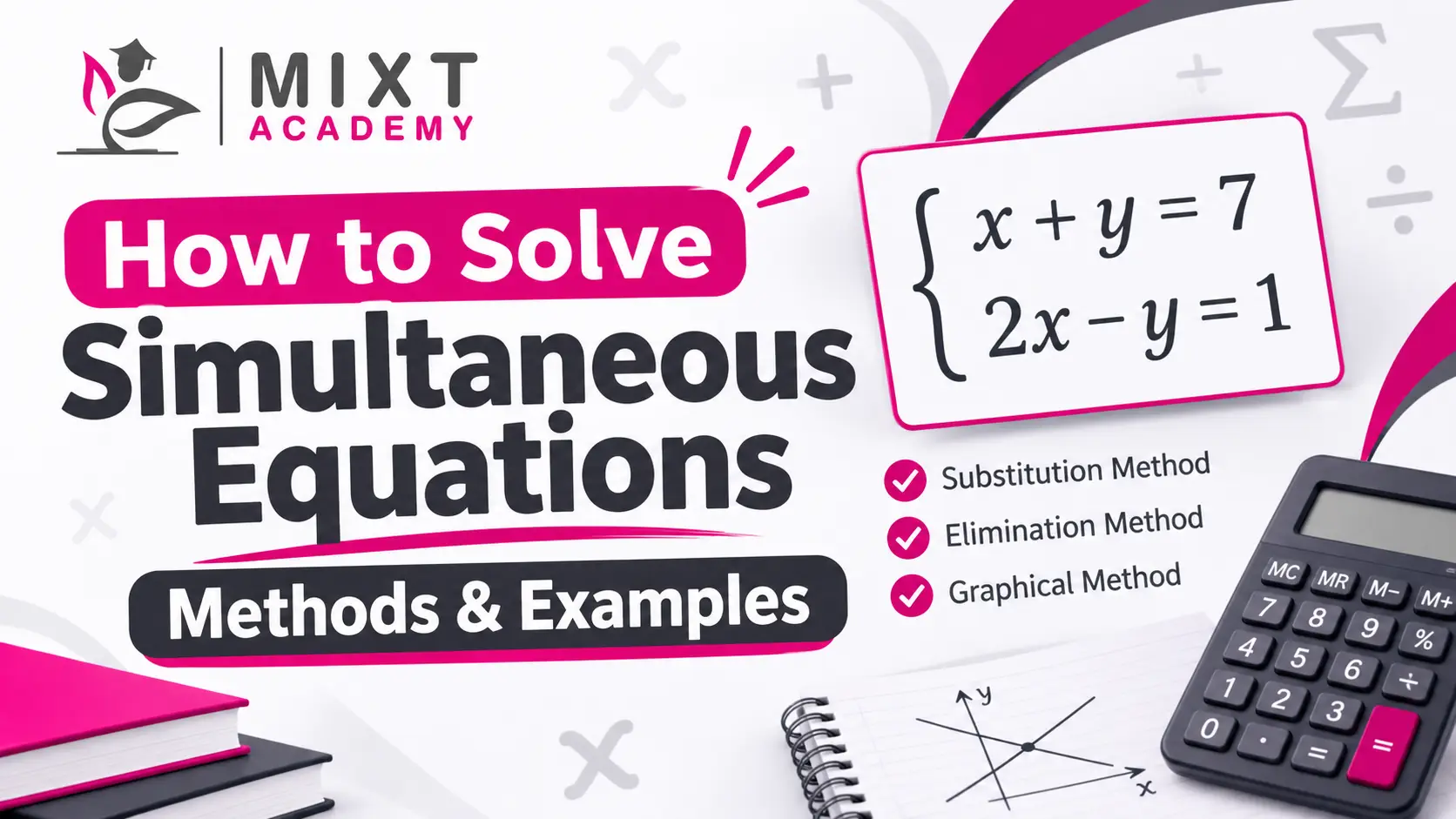
The key to solving these questions is understanding when to use substitution, elimination or graphical methods. Each approach follows a different process, but all aim to find the same solution.
This guide from Mixt Academy explains each method through worked examples, practical calculator instructions and common exam mistakes. You will also learn how to check your answers and recognise which approach suits a particular question.
What Are Simultaneous Equations
Simultaneous equations are two or more mathematical equations containing the same unknown variables. You solve them together because the answer must make every equation true. For example:
Equation 1: x + y = 10
Equation 2: x − y = 4
Both equations contain x and y. Your task is to find values for these variables that satisfy both conditions.
The solution is x = 7 and y = 3
You can check these values by substituting them into the original equations:
First equation: 7 + 3 = 10
Second equation: 7 − 3 = 4
Both equations are correct, so x = 7 and y = 3 is the solution.
The main principle is simple. A correct answer must work in every equation, not just one. Simultaneous equations usually involve two variables at GCSE, although students can encounter three or more unknowns in advanced mathematics. Their solutions may be found through algebraic calculations or by identifying where graphs intersect.
Which Method Should You Use
There are three common methods for solving pairs of linear simultaneous equations. Your choice depends on how the equations are written and which calculation requires fewer steps.
| Method | When to Use It | Main Approach |
|---|---|---|
| Substitution | One equation can easily be rearranged to make a variable the subject. | Replace one variable with an equivalent expression. |
| Elimination | One variable has matching or easily matched coefficients. | Add or subtract equations to remove a variable. |
| Graphical Method | You need to understand or identify where two equations intersect. | Draw both lines and find their intersection. |
For example, substitution is often convenient when an equation already contains x = or y =. Elimination is usually quicker when both equations have matching coefficients.
Graphing helps you understand the relationship between two equations, although the intersection may not provide an exact answer when it falls between grid points. Working alongside expert maths tutors online can also help you quickly master when to apply each specific method.
How to Solve Simultaneous Equations Using Substitution
The substitution method involves expressing one variable in terms of another and replacing that variable in the second equation. This approach works particularly well when one equation can be rearranged with minimal calculations. It is commonly taught in GCSE mathematics and remains useful for more advanced algebra.
Worked Example 1
Solve the following simultaneous equations: x + y = 10
x − y = 4
Step 1: Rearrange the first equation
Start with: x + y = 10
Make x the subject by subtracting y from both sides.
x = 10 − y
Step 2: Substitute the expression into the second equation
The second equation is: x − y = 4
Replace x with 10 − y.
(10 − y) − y = 4
Step 3: Simplify and calculate y
Remove the brackets and combine the terms.
10 − y − y = 4
10 − 2y = 4
Subtract 10 from both sides.
−2y = −6
Divide both sides by −2.
y = 3
Step 4: Calculate x
Return to the rearranged first equation: x = 10 − y
Substitute y = 3.
x = 10 − 3
x = 7
Final Answer:
x = 7 and y = 3
Step 5: Check both values
Substitute x = 7 and y = 3 into both original equations.
7 + 3 = 10
7 − 3 = 4
Both statements are correct. This final check confirms that your solution satisfies both equations. It also helps you identify mistakes before moving to the next question.
How to Solve Simultaneous Equations Using Elimination
The elimination method removes one variable by adding or subtracting the equations. It is particularly useful when the coefficients of a variable are already equal or can be made equal through multiplication.
Unlike substitution, you do not need to rearrange one equation first. You simply organise the equations so that one variable disappears during the calculation.
Worked Example 2
Solve:
2x + y = 11
2x − y = 5
Step 1: Write both equations underneath each other
2x + y = 11
2x − y = 5
Notice that the coefficient of x is 2 in both equations. The y terms have opposite signs.
Step 2: Add the equations
Adding both equations eliminates y because +y and −y cancel each other.
(2x + y) + (2x − y) = 11 + 5
2x + 2x + y − y = 16
4x = 16
Divide both sides by 4.
x = 4
Step 3: Substitute the value of x
Use the first original equation: 2x + y = 11
Replace x with 4.
2(4) + y = 11
8 + y = 11
Subtract 8 from both sides.
y = 3
Final Answer: x = 4 and y = 3
What If the Coefficients Are Different
Sometimes neither variable has matching coefficients. You can multiply one or both equations to create matching values before eliminating a variable.
Consider:
3x + 2y = 16
2x − 2y = 4
The coefficients of y are +2 and −2. Adding the equations removes y immediately.
(3x + 2y) + (2x − 2y) = 16 + 4
5x = 20
x = 4
Substitute x = 4 into the first equation:
3(4) + 2y = 16
12 + 2y = 16
2y = 4
y = 2
The solution is x = 4 and y = 2.
When you multiply an equation, remember to multiply every term, including the number on the right-hand side. Missing one term can change the entire answer.
How to Solve Simultaneous Equations Graphically
The graphical method involves drawing both equations on the same coordinate grid. The point where the two lines intersect represents the solution. Each linear equation produces a straight line. The coordinates of their intersection provide the values of x and y that satisfy both equations.
Worked Example 3
Consider these equations:
y = 2x + 1
y = −x + 7
Step 1: Create a table of values
For the first equation, y = 2x + 1:
| x | y |
|---|---|
| 0 | 1 |
| 1 | 3 |
| 2 | 5 |
For the second equation, y = −x + 7:
| x | y |
|---|---|
| 0 | 7 |
| 2 | 5 |
| 4 | 3 |
Step 2: Plot Both Lines
Mark the coordinates from each table on the same graph. Draw a straight line through the points belonging to each equation.
Step 3: Find the Intersection
Both lines meet at (2, 5)
Therefore: x = 2 and y = 5
You can confirm this by substituting the values into the original equations.
First equation:
5 = 2(2) + 1
5 = 5
Second equation:
5 = −2 + 7
5 = 5
Both equations are satisfied.
What Happens When Two Lines Do Not Meet
The relationship between the lines also tells you how many solutions a pair of linear equations has.
- One solution: The lines intersect at a single point.
- No solution: The lines are parallel and never intersect.
- Infinitely many solutions: Both equations represent the same line.
This makes graphing useful for understanding why some simultaneous equations have one, no or infinitely many solutions.
Solving Linear and Quadratic Simultaneous Equations
At GCSE Higher level and in more advanced mathematics, you may encounter simultaneous equations containing both linear and quadratic expressions. These questions require you to combine substitution with factorisation or another suitable method for solving quadratic equations.
Worked Example 4
Solve:
y = x²
y = 2x + 3
Step 1: Equate the expressions
Both equations equal y, so: x² = 2x + 3
Move every term to one side: x² − 2x − 3 = 0
Step 2: Factorise the quadratic equation
Find two numbers that multiply to −3 and add to −2. These numbers are −3 and +1. Therefore: (x − 3)(x + 1) = 0
Step 3: Calculate both possible values of x
Set each bracket equal to zero.
x − 3 = 0
x = 3
Or:
x + 1 = 0
x = −1
Step 4: Calculate the corresponding values of y
Use the original equation y = x².
When x = 3: y = 3² = 9
When x = −1: y = (−1)² = 1
Final Answers:
(x, y) = (3, 9)
(x, y) = (−1, 1)
There are two solutions because the straight line intersects the quadratic graph at two points. At A-level, students may encounter more involved simultaneous equations within algebraic and mathematical modelling questions. Understanding substitution, rearrangement and factorisation provides a useful foundation for tackling these problems.
How to Solve Simultaneous Equations Using a Casio Calculator
A scientific calculator can help you check solutions and reduce arithmetic errors when solving simultaneous linear equations. For example, the Casio fx-991CW+ UK includes an Equation app with a Simul Equation function. It supports simultaneous linear equations involving two to four unknowns.
Consider the same pair of equations:
x + y = 10
x − y = 4
To enter these equations, first arrange them in the standard form: ax + by = c
You need 3 values for each equation: the coefficient of x, the coefficient of y and the constant on the right-hand side. The required values are:
| Equation | x Coefficient | y Coefficient | Constant |
|---|---|---|---|
| x + y = 10 | 1 | 1 | 10 |
| x − y = 4 | 1 | −1 | 4 |
Calculator Steps for the Casio fx-991CW+ UK
Follow these steps to check the solution:
- Press the HOME button to open the calculator’s main screen.
- Select the Equation app and press EXE.
- Choose Simul Equation from the available options.
- Select 2 Unknowns.
- The coefficient editor will appear on the screen.
- Enter the first equation’s coefficients in order: 1, 1 and 10.
- Enter the second equation’s coefficients: 1, −1 and 4.
- Check that every coefficient is in the correct position.
- Press EXE to calculate the solution.
- Read the displayed value of x and use the down arrow or EXE to display the value of y.
The calculator should return:
x = 7
y = 3
These values match the answers obtained through substitution and elimination.
How Should You Use a Calculator During Revision
A calculator should support your understanding rather than replace the algebraic working required by a question. Try this approach during revision:
- Solve the equations manually before entering their coefficients.
- Check the signs of positive and negative values before calculating.
- Compare the calculator’s answers with your algebraic solution.
- Substitute the final values into both original equations.
- Practise entering different coefficients until you understand the calculator’s equation function.
The Casio fx-991CW+ UK also offers polynomial calculations, which can help with certain quadratic equations. Check your examination board’s permitted calculator list before taking a model into an exam.
Simultaneous Equations in GCSE and A-Level Exams
Simultaneous equations appear in different forms across secondary and advanced mathematics. The main difference is the level of algebraic reasoning and the type of problem students need to solve.
GCSE Maths
At GCSE, questions commonly focus on solving pairs of linear equations through substitution and elimination. Students may also need to interpret graphical solutions or solve simultaneous equations involving a linear and a quadratic expression. Exam questions often test whether you can:
- Rearrange equations accurately.
- Select an appropriate solving method.
- Show clear algebraic working.
- Handle negative numbers and fractions.
- Check that both equations are satisfied.
- Apply simultaneous equations to word problems.
For example, a question might describe the cost of two types of tickets and provide two conditions involving their total price and quantity. You must form two equations before calculating the unknown prices.
Students studying AQA, Pearson Edexcel or OCR should practise questions that match their examination board’s specification.
A-Level Maths
In A-level maths, simultaneous equations can appear within more complex algebraic problems and mathematical models. You may need to combine different mathematical techniques to obtain the required values.
A strong understanding of rearranging equations, substitution and solving quadratic expressions helps when working through these questions. Students who need support with advanced algebra can explore Online A-Level maths tutors for subject-specific guidance and examination practice.
6 Common Mistakes When Solving Simultaneous Equations
Even when you understand the main methods, small algebraic errors can produce incorrect answers. Recognising these problems helps you improve accuracy and avoid losing marks in examinations.
- Choosing the Wrong Operation: When using elimination, adding equations with matching signs will not remove the variable. Check whether the coefficients are equal or opposite before deciding to add or subtract.
- Making Sign Errors: Negative values can cause problems during rearrangement and substitution. For example, subtracting −3 is the same as adding 3. Write each step separately when working with negative numbers.
- Forgetting to Multiply Every Term: When creating matching coefficients, multiply every term on both sides of the equation. Multiplying only the variable terms changes the original relationship.
- Substituting Incorrectly: Always place the complete expression inside brackets when replacing a variable. For example, substituting x = 10 − y into x − y gives (10 − y) − y, not 10 − y − y without checking the original expression.
- Finding Only One Quadratic Solution: A quadratic equation can produce two possible values of x. Calculate the corresponding y-value for each root instead of stopping after finding the first solution.
- Skipping the Final Check: A value that satisfies one equation may not satisfy the other. Substitute your final answer into both original equations before treating it as correct.
For students who need more guided practice, GCSE maths tutoring can help strengthen these problem-solving skills. Mixt Academy UK provides one-to-one lessons where students practise algebra, review exam-style questions and receive explanations based on their learning needs.
Where Are Simultaneous Equations Used in Real Life
Simultaneous equations are not limited to textbook exercises. They provide a way to calculate unknown quantities when two or more conditions apply at the same time. For example, a shop sells adult and child tickets at different prices.
You know the total number of tickets sold and the total amount collected. By forming two equations, you can calculate the price of each ticket type. Other applications include:
- Engineering: Calculating unknown forces and measurements in mechanical systems.
- Economics: Comparing costs, revenue and different financial conditions.
- Physics: Solving problems involving distance, speed, time and physical relationships.
- Computer Science: Working with mathematical models and systems of constraints.
- Business: Finding unknown quantities when sales figures and total revenue are available.
These applications show why understanding simultaneous equations is useful beyond GCSE and A-level examinations.
Get Support With GCSE and A-Level Maths
Finding simultaneous equations difficult? Expert guidance can help you understand the methods, improve your algebraic working and prepare for examination questions.
At Mixt Academy, students receive personalised one-to-one online lesson based on their curriculum and learning needs. Explore the available GCSE maths tutors and book a free trial session to discuss your learning goals.