
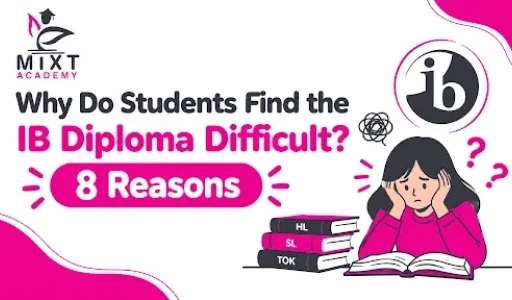
Is IB hard? For most students, yes, it’s demanding, mainly because of the workload. You have six subjects, plus the Extended Essay, Theory of Knowledge, and CAS, all with overlapping deadlines over two years. Still, it’s manageable. In May 2026, 82.61% of students worldwide passed. With early planning and the right tutoring support, it gets much easier.
The IB Diploma is known as one of the toughest school qualifications, and that reputation is mainly deserved. Most of the challenge comes from the programme’s structure, not from the content being too hard. This guide covers why students struggle, what the official numbers say, how the passing rules work, and how to tackle each problem.
What the Numbers Say About IB Difficulty
Statistics give a more balanced view than anecdotes. TES reported the following for the May 2026 session:
| Measure | May 2026 |
| Global pass rate | 82.61% |
| Average score | 30.88 out of 45 (30.58 in 2025) |
| Candidates scoring over 40 | 10,526 |
| Students receiving grades | 209,607 across 3,442 schools |
There are three main takeaways. First, most students pass. Second, the average score is about 31, so anything in the mid-thirties is already above average. Third, only about 5% of students scored over 40, which explains why top scores seem rare. Some Middle East students received teacher-assessed grades after exam cancellations, so be careful when comparing results across years.
Worried About Your Child’s Grades?
Give give them personalised support from qualified UK tutors who make learning easier and more enjoyable.How the IB Diploma Is Structured
Students taking the IBDP choose one subject from each of six groups, three at the higher level and three at the standard level, and each is graded from 1 to 7. They also complete three core components:
- The Extended Essay: An independent research paper of up to 4,000 words.
- Theory of Knowledge (TOK): An essay and an exhibition on how we know what we claim to know.
- CAS: Creativity, activity and service. It is not graded, but completion is required.
The highest possible score is 45: you get 42 from the six subjects, plus up to 3 bonus points from the Extended Essay and TOK. Anyone asking, is IBDP difficult? should start here, because this structure explains most of the pressure.
Eight Reasons Students Find the IB Diploma Difficult
Whether you ask, is IB difficult? For students and parents, the answer usually comes down to these eight causes.
1. Breadth means constant context-switching.
Switching from a maths problem set to a literature essay and then to a chemistry practical all in one day can be exhausting. A-level students usually focus on three subjects, but IB students handle six, so it’s easy to get mentally tired.
2. The core adds a second workload.
The Extended Essay, TOK, and CAS all happen at the same time as your regular subjects. Many students don’t realise how much time independent research takes, and the core work often gets busiest right when mock exams start.
3. Overlapping internal assessments
Every subject has its own coursework, called internal assessment, each with a different deadline. When several deadlines land in the same two weeks, even organised students can feel overwhelmed.
4. Exam technique is a skill of its own.
IB exams reward students who pay close attention to command terms like “evaluate,” “discuss,” and “to what extent.” If you know the material but misread these terms, you can lose marks you might have earned.
5. Writing is assessed everywhere.
With essays, reflections, lab reports, and oral commentaries in many subjects, students who find writing difficult can struggle, not just in English. This is especially tough for those studying in a second language.
6. Weak foundations show up quickly.
Gaps in your earlier learning show up quickly, especially in higher-level subjects. Choosing a higher-level subject just because your friends did, instead of what suits you, often leads to problems.
7. Perfectionism and poor time management
Many students spend hours perfecting one reflection while other tasks, like a lab report, wait. Tutoring providers often say students need 15 to 25 hours of independent study a week during busy times, but this is just an estimate and can vary by student and school.
8. Stress and sleep debt
Dealing with pressure for two years can be exhausting. Not getting enough sleep hurts your memory and focus, which makes all the other challenges even harder.
Is the IB Harder Than A-Levels?
Students often wonder if the IB is harder than A-levels. The truth is, they’re challenging in different ways. A-levels focus on depth in three subjects and require a deep understanding for top grades. The IB covers six subjects and adds independent research and reflection. A 2017 survey of UK admissions officers, reported by Times Higher Education, found that 94% thought A-levels develop strong subject expertise, compared to 56% for the IB.
Meanwhile, 94% said the IB develops independent inquiry well, compared to 49% for A-levels. The survey is a bit old and measures opinions, not results, but it matches what many people see in practice. Pick the path that suits your strengths.
The Passing Rules, Explained
Fear of failing often makes the IB feel harder than it is, so know the rules:
- A student needs at least 24 points to earn the diploma, plus the other conditions.
- Core grades for the Extended Essay and TOK are A to E, and together they earn 0 to 3 points. Certain combinations, such as an E in either component, count as failing conditions.
- CAS completion is required and is judged by the school.
- You may have no more than two grade 2s and no more than three grades of 3 or below.
- Higher-level subjects need at least 12 points in total, and standard-level subjects at least 9.
Check the current criteria with your school’s IB coordinator, because they are the authority for your cohort.
Myth vs Reality
| Myth | Reality |
| Only geniuses pass the IB. | The pass rate was 82.61% in May 2026. |
| You need 40+ to succeed. | The average is about 31, and offers vary by course, so check your target university. |
| It is all exams | Coursework, the Extended Essay, and TOK carry real weight |
| Hard work alone is enough. | Planning and exam technique matter just as much. |

Consult with one of our 1,000+ qualified tutors.
How to Make the IB Diploma Manageable
- Start by planning backwards from your deadlines. Put every internal assessment, Extended Essay milestone, and TOK deadline on one calendar, and set your own deadlines a few days before the official ones.
- Begin your Extended Essay early. Pick a topic you’re interested in and make sure your question is focused enough to answer in 4,000 words.
- Practice with past papers under timed conditions. This helps you learn command terms and pacing much better than just rereading your notes.
- Try active recall: close your notes, write down what you remember, and then check your answers.
- Switch between subjects. Short, focused sessions on different topics help prevent fatigue.
- Look at the mark scheme. Focus on what earns marks, not just whether your answer is right.
- Make sure to get enough sleep and take breaks. Teenagers need about eight to ten hours of sleep, so try to keep at least one evening a week free.
- Ask for help as soon as you need it. Support is most effective before a small problem turns into a big one.
Warning Signs to Act On
Get help if a student is missing several deadlines, avoiding a subject, not sleeping well, or losing interest in things they used to enjoy. Talk to the IB coordinator and form tutor first, and think about extra academic or wellbeing support from the school.
How Parents Can Help
Instead of counting study hours, ask your child what the hardest task of the week is. Help them notice when deadlines are close together, keep things calm at home during busy times, and celebrate their effort. Don’t compare scores with other students, since averages vary by subject and school.
Getting Extra Support
Personal feedback can make a big difference, since it’s hard to spot your own gaps in essays and internal assessments. If you’re searching for online IB tutors in UK you can find one-to-one lessons where tutors mark practice answers, explain command terms, and help keep extended essay drafts on track. Mixt Academy UK offers live one-to-one online tutoring for IB students, with a free first session so you can see if the tutor’s style fits you. When picking a tutor, ask which subjects and levels they teach, how they give written feedback, and how they track your progress.
FAQs
Why do students find the IB Diploma difficult?
The main reason is the workload. Students take six subjects, complete three core components, manage overlapping deadlines, and write a lot over two years.
What percentage of students pass the IB Diploma?
In May 2026, the global pass rate was 82.61%. This figure comes from TES, which reported on IB results.
What is a good IB score?
The average IB score is about 31 out of 45. If you score in the mid-thirties, that’s above average. Anything over 40 is considered exceptional.
What happens if I score below 24 points?
You will not earn the diploma, but you might still get certificates for individual subjects. Talk to your coordinator to find out what options you have.
Is the Extended Essay the hardest part?
For many students, the Extended Essay is the biggest single task. However, if you start early and pick a focused question, it becomes much more manageable.
Is the IB Diploma harder than A-levels?
The IB is not just harder; it is different. It requires you to study a wider range of subjects and handle a heavier workload. A-levels focus more on depth in fewer subjects.
Can a tutor really help with the IB?
Yes, a tutor can help with exam technique, writing feedback, and planning. However, your own effort still matters most for your results.
Should I drop the IB if I am struggling?
You should not drop the IB right away. Speak to your IB coordinator first. Sometimes, getting extra support or changing your subject levels can help more than leaving the programme.