
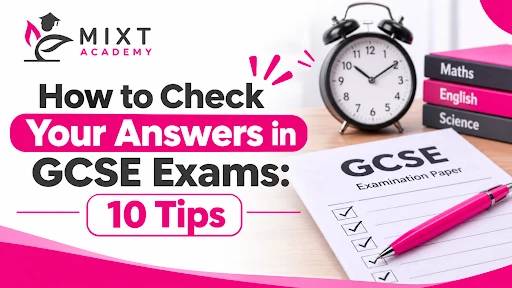
Here’s a quick answer: Save the last five to ten minutes to check your answers. Re-read each question, make sure your answers make sense, double-check units and calculations, and confirm you haven’t missed anything. These steps help you catch small mistakes that can cost marks.
Lots of students lose marks not because they don’t know the material but because they don’t review their work. Advice like “always check your work” isn’t really a method. This guide gives you a routine you can use for maths, science, and English on AQA, Pearson Edexcel, and OCR papers. Try these GCSE exam tips in every mock exam so checking becomes a habit by the real exam.
1. Plan Your Checking Time Before You Start
Use the total marks and exam duration to plan your time. Around one minute per mark can be a useful starting point for some papers, but adjust your pace to suit the subject and question types. Set time checkpoints during the exam and, where possible, leave the final five to ten minutes to review your answers.
2. Re-Read the Question, Then Your Answer
After answering, return to the question and underline command words such as “calculate”, “explain” or “compare”. Ask: did I do exactly what was asked? Students often calculate an area when a perimeter is requested or answer in centimetres when metres are required.
3. Run a Sense Check
Check if your answer makes sense. For example, a probability should be between 0 and 1. The shorter side of a right-angled triangle should be less than the hypotenuse. An average age can’t be 230. In science, make sure speeds, masses, and concentrations are reasonable. If you get a messy decimal in maths when you expect a neat answer, you may have made a mistake. If something looks odd, take it as a sign to calmly check again, not panic.
4. Estimate First, Then Compare
Round the numbers before you calculate. For example, for 4.9 × 21, think of it as 5 × 20 = 100, then compare this to your actual answer. This only takes a few seconds and can help you spot mistakes like missing a digit, forgetting a bracket, or pressing the wrong key on your calculator.
5. Check Units, Rounding and Accuracy
Make sure you use the correct units and convert them if needed. Check if the question asks for decimal places or significant figures. When you have several steps, keep numbers unrounded until the end, because rounding early can lead to bigger mistakes.
6. Verify by Working Backwards
For equations, put your answer back into the original equation to see if both sides are equal. In science, rearrange the formula and check if you get back to the starting values. For suitable calculations, substitute your answer into the original equation or use the inverse operation to check your result. In science, you can also check the formula, units and whether the answer is reasonable. These methods can help you spot errors, although no single checking method guarantees that an answer is correct.
7. Match Every Mark to a Point
Check how many marks a question is worth and make sure your answer includes enough relevant detail. However, don’t assume that every mark requires a separate point. Some questions award marks for working, developed explanations, evidence or linked reasoning. Always follow the command word and answer the question that has been asked.
8. Make Your Working Easy to Check
Write one step per line and make sure your minus signs are clear. Messy handwriting can turn a minus into a plus or an S into a 5. Show your working clearly, especially in calculation-based questions, because you may earn method marks even if your final answer is incorrect. If you are running out of time, try to make a relevant attempt at unanswered questions rather than leaving them blank. Even a partly correct method or explanation may earn marks, depending on the mark scheme. A GCSE grade boundary is the minimum raw mark a student needs, across a whole qualification, to be awarded a particular grade.
9. Use a Two-Pass Checking Order
As you work through the exam, mark any questions you’re not sure about. When you start checking, review these marked questions first. Next, scan the whole paper to make sure you haven’t missed any pages, back-of-the-paper questions, or parts you didn’t answer. Change an answer only if you’re sure you made a mistake. Don’t change it just because you feel nervous.
10. Practise Checking Under Timed Conditions
Practise checking your answers using past papers. Mark your work with the mark scheme and write down any mistakes you spot while checking, such as wrong units, signs, or misread questions. If you do this regularly, you’ll develop a solid GCSE exam technique that works under pressure. Aim to practise this every week before your exams so checking becomes a natural part of your routine.
Common Mistakes to Watch For
Know what to look for, because checking without a goal is just rereading. Common mistakes include missing or flipped minus signs, copying numbers incorrectly, misreading values from graphs or tables, missing a second part of a question, and spelling key scientific terms wrong. Keep this list in mind and check for each one on purpose. Go through each category as you check; the whole process takes only a few minutes.
Your Five-Minute Checking Routine
- Scan for unanswered questions and missed pages.
- Re-read starred questions and attempt them again.
- Sense-check final answers and units.
- Substitute back for equations and calculations.
- Compare marks with points made.
Get Expert Help With Checking Habits
A tutor can mark your timed papers, spot mistakes you keep making, and help you pace yourself. Because every student has their own common slips, regular tutor feedback helps you improve faster. With GCSE online tutors, you can get personalised feedback from home, and families looking for “online tutors in London” can get support without travelling. Mixt Academy UK connects students with tutors who build exam confidence through one-to-one practice.
WE Answer Every Question of Parents
How many minutes should I leave to check answers in a GCSE exam?
Try to leave five to ten minutes at the end of a typical paper and a bit more time for longer papers. Decide on this time window before the exam begins.
What is the quickest way to check GCSE Maths answers?
Start by estimating your answer, then check if it makes sense. Make sure your units and rounding are correct, and finally, substitute your answer back into the equations to confirm.
Should I change an answer when I check it?
Change your answer only if you spot a clear mistake. If you change answers without a good reason, you might turn a correct answer into a wrong one.
Do these tips work for English and science?
Yes, these tips also work for English and science. Re-read the question, make sure your points match the marks, check your evidence and terminology, and confirm you’ve answered every part.
What if I am running out of time and cannot check everything?
If you’re running out of time, focus on unanswered questions first, then tackle the ones worth the most marks, and finally do quick sense checks. Remember, even partial answers can earn marks, but blank spaces always get zero.
Can a tutor help me get better at checking?
Yes, an online tutor in London can help by reviewing your timed papers, spotting repeated mistakes, and teaching you routines that make checking quicker and more accurate.