
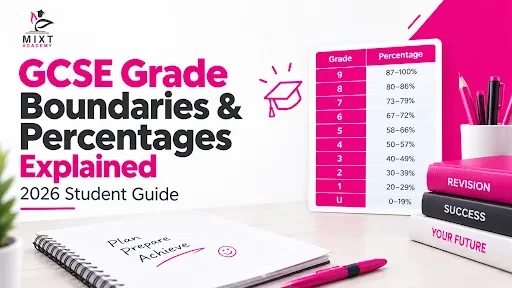
Search what percentage is a grade 7 GCSE, and you will find a lot of confident, wrong answers. Many sites publish one fixed percentage chart and apply it to every GCSE, every subject, every year. That is not how GCSE grading works.
The mark a student needs for a grade depends on the exam board, the qualification, the subject, the tier and the exam series. A 91% grade boundary in one maths qualification and an 88% boundary in another do not, by themselves, show that one qualification was easier or harder.
Mixt Academy professionals’ guide uses real June 2026 GCSE maths data from AQA, Pearson Edexcel and OCR to show exactly how boundaries work. It also explains what UK students studying international qualifications should actually check.
What Are GCSE Grade Boundaries
A grade boundary is the minimum raw mark a student needs, across a whole qualification, to be awarded a particular grade. Raw marks come from every exam paper in that qualification, combined and weighted as the specification requires. Boundaries are only confirmed after marking, once senior examiners and awarding organisations have reviewed the completed papers for that series. Take AQA GCSE Maths Higher (8300H) in June 2026. The grade 7 boundary was 166 out of 240 marks.
166 ÷ 240 × 100 = 69.2%
That figure helps you understand one qualification in one series. It is not a universal grade 7%, because a different subject, board or year can set a completely different boundary.
Are GCSE Grade Boundaries Fixed Percentages
No! There is no single percentage chart that applies across GCSEs. Boundaries can move up or down between exam series, sometimes by several marks. Awarding organisations reassess where the standard for each grade falls every time.
Ofqual, the exams regulator for England, says this process protects standards rather than fixing outcomes. No quotas require a set number of students to receive a given grade, and no cap limits how many can achieve it. Grading aims to keep a grade 7 in 2026 worth the same as a grade 7 in an earlier series. The raw marks needed to get there can still differ.
GCSE Grades 9 to 1 Explained
Numerical grades do not map neatly onto the old A* to G letter grades. Grade 9 was introduced to provide greater differentiation among the highest-performing students and represents a higher standard than the old A at the top of the grading scale.
| Grade | General Meaning |
| 9 | Highest GCSE grade |
| 8 | Very high achievement |
| 7 | High achievement |
| 6 | Strong achievement |
| 5 | Often described as a strong pass in accountability measures |
| 4 | Standard pass |
| 3 | Below the standard pass threshold |
| 2 | Lower attainment |
| 1 | Lowest numbered grade |
| U | Ungraded |
What Percentage Do You Need for Each GCSE Grade
There is no single answer to this question, which surprises many students. The percentage needed depends on several factors: subject, qualification, exam board, specification, tier, maximum mark, and exam series.
Two qualifications with different maximum marks can need very different percentages for the same grade, even in the same subject. The June 2026 maths tables below show this clearly. Treat them as real examples from one subject and series, not as a template for every GCSE. But some students get external support from the online GCSE tutors to achieve better grades.
GCSE Grade Boundaries 2026: Real Percentage Examples
These are the actual June 2026 GCSE maths qualification level boundaries. Percentages are added only to make the raw marks easier to read, not as a universal scale.
Higher Tier
| Exam Board | Specification | Max Marks | Grade 9 | Grade 8 | Grade 7 | Grade 6 | Grade 5 | Grade 4 | Grade 3 safety net |
| AQA | 8300H | 240 | 219/240 (91.3%) | 192/240 (80.0%) | 166/240 (69.2%) | 131/240 (54.6%) | 97/240 (40.4%) | 63/240 (26.3%) | 46/240 (19.2%) |
| Pearson Edexcel | 1MA1 Higher | 240 | 208/240 (86.7%) | 177/240 (73.8%) | 146/240 (60.8%) | 114/240 (47.5%) | 82/240 (34.2%) | 50/240 (20.8%) | 34/240 (14.2%) |
| OCR | J560 Higher | 300 | 264/300 (88.0%) | 217/300 (72.3%) | 170/300 (56.7%) | 132/300 (44.0%) | 94/300 (31.3%) | 57/300 (19.0%) | 38/300 (12.7%) |
Foundation Tier
| Exam Board | Specification | Max Marks | Grade 5 | Grade 4 | Grade 3 | Grade 2 | Grade 1 |
| AQA | 8300F | 240 | 187/240 (77.9%) | 154/240 (64.2%) | 115/240 (47.9%) | 76/240 (31.7%) | 38/240 (15.8%) |
| Pearson Edexcel | 1MA1 Foundation | 240 | 181/240 (75.4%) | 151/240 (62.9%) | 110/240 (45.8%) | 69/240 (28.8%) | 29/240 (12.1%) |
| OCR | J560 Foundation | 300 | 183/300 (61.0%) | 133/300 (44.3%) | 96/300 (32.0%) | 59/300 (19.7%) | 23/300 (7.7%) |
AQA and Edexcel GCSE Maths both use a 240-mark total, while OCR uses 300 marks. Converting the boundaries to percentages makes the figures easier to compare, but those percentages should not be used to decide which board is easier or harder. Each board uses different papers, and grade boundaries are set to maintain comparable standards across exam series and awarding organisations.
National Outcomes Are Not Grade Boundaries
This distinction trips up many students and parents, so it deserves its own table.
| Measure | England, all GCSE results, 2026 | England, 16-year-olds, 2026 |
| Grade 7 or above | 21.80% | 23.10% |
| Grade 4 or above | 67.00% | 70.70% |
These figures describe the share of results awarded at or above a grade across 5,720,045 GCSE results issued in England in summer 2026. They do not mean a student needed 21.8% of the marks to get a grade 7 or 67.0% to get a grade 4. One statistic is about how many students reached a grade. The other, covered in section 5, is about how many marks were needed to reach it. Confusing the two leads directly to the “70% equals grade 7” myth.
Foundation vs Higher Tier GCSE Grade Boundaries
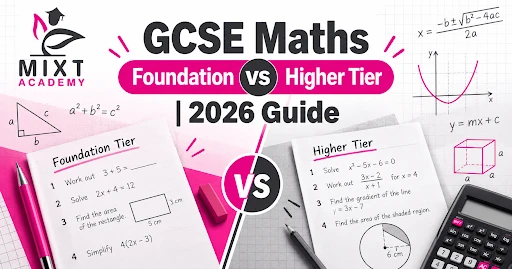
Not every GCSE is tiered, but several are, including Mathematics, Combined Science, Biology, Chemistry, Physics, Statistics and modern foreign languages. The foundation tier generally covers grades 5 down to 1. The higher tier covers grades 9 down to 4.
A narrow grade 3 safety net is available in relevant qualifications for students who narrowly miss grade 4. Combined Science awards paired grades, such as 5-5 or 4-4, reflecting the two GCSEs it represents. Students and parents should check which tier a student has entered for well before results day. This decides which grades are even possible.
How Raw Marks Become GCSE Grades
The process runs in a fixed sequence. A student sits the exam papers, examiners mark each script, and raw marks are recorded for every question. Components are combined and weighted as the specification sets out. Awarding organisations then use marking evidence, statistical data and senior examiner judgement to set the qualification level boundaries for that series.
A student’s total mark is compared against those boundaries, and the final grade is issued. AQA and OCR both note that “notional” boundaries shown for individual components are not official grades on their own. Only the qualification level boundary determines the final result.
Why Do GCSE Grade Boundaries Differ Between Subjects and Years?
GCSE grade boundaries differ by subject because each exam has its own structure, marking scheme and level of difficulty.
- Different Exam Structures: Each subject uses different paper formats, question types and maximum marks.
- Varied Assessment Skills: Maths may focus on problem solving, while English includes extended writing and analysis.
- Different Marking Demands: Subjects assess different knowledge, skills and levels of written response.
- Separate Qualifications: Each awarding organisation sets boundaries for its own qualifications and specifications after reviewing performance in that exam series.
- Percentages Need Context: A lower Grade 9 percentage does not automatically mean the subject is easier.
How to Calculate a GCSE Grade Boundary Percentage
These calculations help you understand past boundaries in detail. They cannot predict future boundaries, because each series is assessed on its own evidence. The formula is simple:
Grade boundary percentage = boundary mark ÷ maximum mark × 100
Three worked examples from the June 2026 Maths tables:
- 219 ÷ 240 × 100 = 91.3% (AQA Higher, grade 9)
- 208 ÷ 240 × 100 = 86.7% (Edexcel Higher, grade 9)
- 264 ÷ 300 × 100 = 88.0% (OCR Higher, grade 9)
How Students Should Use Grade Boundaries for Revision
Historical boundaries are a genuinely useful revision tool if used correctly. They show the rough mark range a grade has needed in recent series, which helps students set realistic targets. The mistake is aiming to score exactly at a past boundary, since that leaves no margin if the next boundary moves up.
A more reliable approach works better. Set a target comfortably above the most recent boundary, then work through past papers under timed conditions regularly. Working with GCSE maths tutors in UK can also help students review every mistake, not just the final score, and track raw marks by topic to spot weak areas. Comparing mock results over several months shows real progress far better than one score in isolation.
How to Find Your Exact GCSE Grade Boundary
Before searching for a boundary, check seven things: exam board, subject, qualification code, specification, tier, exam series and total marks available. Once you have these, go to the relevant exam board’s official website.
AQA, Edexcel and OCR each publish their own grade boundary documents from results day. Avoid relying on old third-party calculators as a final source. Your school or exams officer can also confirm the exact specification a student is entered for.
GCSE vs International GCSE: What UK Students Need to Check
This matters for every family in the UK reading this. Many UK schools enter students for International GCSE qualifications rather than the GCSE qualifications regulated in England, and the two are not interchangeable. You cannot automatically apply an AQA GCSE boundary to a Pearson Edexcel International GCSE, a Cambridge International qualification, or any other international specification.
Before searching for a boundary, check your school’s statement of entry, timetable or results documentation for the exact qualification code. Two students at different UK schools studying GCSE maths may be sitting entirely different qualifications with entirely different boundaries.
What Happens If You Are Close to a Grade Boundary
Being one or two marks from the next grade is common, and schools do have post-results review options. A review does not guarantee a higher grade; marks can also stay the same or occasionally fall. Fees, deadlines and review types change over time. Always confirm current details with your school’s exams officer rather than relying on older information found online.
5 GCSE Grade Boundary Myths Students Should Ignore
- 70% always gives you a grade 7. Boundaries vary by subject, board and year; 70% is not a fixed marker for anything.
- Grade boundaries are the same every year. They are reviewed and can move up or down each series based on evidence.
- A lower boundary means the subject is easier. It usually reflects assessment design and maximum marks, not difficulty.
- Everyone needs the same percentage for a grade 4. Grade 4 boundaries differ across subjects, boards and qualifications.
- The number of students passing determines the boundary. Ofqual confirms there are no quotas for how many students get a grade.
Struggling to Turn Marks Into a Target Grade
Working out where you stand between past papers, mock results and a real target grade is genuinely hard to do alone. If you are unsure which topics are costing you the most marks, or your mock results keep moving in different directions, that is a common problem. Mixt Academy UK works with GCSE students across subjects to turn that uncertainty into a clear, workable revision plan built around your actual papers and boundaries.
Closing of the Guide
GCSE grade boundaries are not fixed percentages, and no single chart applies to every subject, board or year. What matters is the specific qualification, tier and exam series a student is entered for. The June 2026 examples in this guide show real boundaries, not templates to copy elsewhere.
Historical boundaries remain a useful guide for revision, provided students aim comfortably above them rather than exactly at them. The most reliable path to a target grade is strong subject knowledge and consistent past paper practice. Always check the correct exam board, specification and series before assuming what percentage you need.
We Answer Every Question of Parent
What percentage do you need to get a grade 9 in GCSE?
It depends on the subject, board and exam series. In June 2026 GCSE Maths, grade 9 required 91.3% at AQA, 86.7% at Edexcel, and 88.0% at OCR, across different papers with different maximum marks.
What percentage is a grade 7 in GCSE?
There is no fixed figure. In June 2026, AQA Maths Higher set grade 7 at 166 out of 240, or 69.2%, but other subjects and boards set different boundaries.
Is 50% a pass in GCSE?
Not necessarily! Whether 50% reaches a pass grade depends entirely on where that subject’s grade 4 boundary falls for that specific series.
Is grade 4 a pass in GCSE?
Grade 4 is generally described as a standard pass. Grade 5 is often referred to as a strong pass in accountability measures used by schools.
Is a grade 5 better than a standard GCSE pass?
Yes! Grade 5 sits above grade 4 and is described as a strong pass, reflecting a higher standard of achievement than the standard pass.
Can GCSE grade boundaries change each year?
Yes! Boundaries are reviewed every series using marking evidence and statistical comparisons, so the mark needed for a grade can shift each year.
Are GCSE grade boundaries the same for AQA, Edexcel and OCR?
No! Each awarding organisation sets its own boundaries for its own specifications, even within the same subject and exam series.
Are Foundation and Higher GCSE grade boundaries different?
Yes! Foundation and higher