
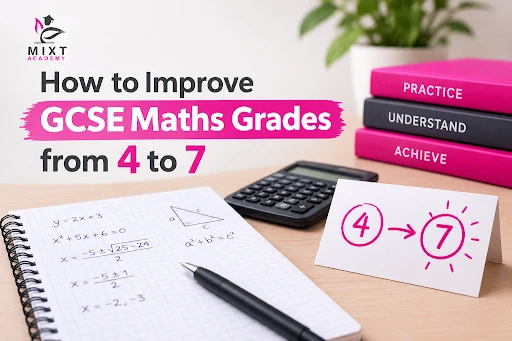
To move from grade 4 to 7 in GCSE maths, take the higher tier, aim for about 56 marks on each 80-mark paper, use an error log to track where you lose marks, work on weak topics with exam-style questions, and do weekly timed papers. Most students need around 12 weeks of steady effort.
Moving from grade 4 to grade 7 is a big step, but you can do it with the right approach. Many people just say to do more past papers, but they rarely explain what to focus on or in what order. This plan gives you clear targets and four phases to follow each week.
Worried About Your Child’s Grades?
Give give them personalised support from qualified UK tutors who make learning easier and more enjoyable.What a Grade 7 Actually Requires
AQA, Pearson Edexcel, and OCR usually set three 80-mark papers, for a total of 240 marks. Grade 7 is often set at about 65-70%, which is around 168 marks, or 56 per paper. These boundaries change each exam series, so use 65-70% as a guide and check your exam board’s latest boundaries.
For example, in June 2025:
| Exam board | Grade 7 boundary |
|---|---|
| AQA Higher | 164/240 (68.3%) |
| Edexcel Higher | 156/240 (65%) |
The tier you choose is important. The Foundation tier only goes up to grade 5, so you need to take the Higher tier to get a grade 7. If you are on Foundation, talk to your teacher early about moving up or read GCSE grade boundaries explained for UK students.
You will see the same topics you learned for grade 4. The difference is that grade 7 questions go deeper. They combine skills, like making an equation from a geometry problem, and expect you to explain or justify each step clearly.
Phase One (Weeks 1 to 2): Find Where Your Marks Leak
Start by doing a full past paper under timed conditions, then mark it carefully using the mark scheme. After that, make an error log with four columns: topic, mark lost, cause (such as a knowledge gap, wrong method, arithmetic mistake, or misreading the question), and how to fix it.
Grade 4 students often get marks on the early, routine questions. To reach a 7, you need to do better on the later, multi-step questions. Pay close attention to where you lose marks after question 15.
Phase Two (Weeks 3 to 8): Rebuild Weak Topics in Priority Order
Pick your three weakest high-value topics from algebra, ratio and proportion, geometry, and probability. Work through each topic using this cycle:
- Relearn one topic at a time, focusing on why the method works instead of just memorising the steps.
- Do eight to ten exam-style questions on that topic.
- Three days later, try every question you missed again, this time without using notes.
Short, frequent study sessions work better than long, rare ones. Studying for 30 to 45 minutes on most days is more effective than doing everything in one weekend.
Phase Three (Weeks 9 to 10): Win the Method Marks
Examiners mark your method, so you can still earn points even if your final answer is wrong. Write one step per line, keep numbers unrounded until the end, and always include units. Don’t leave any blanks, as blank answers get zero marks.
Here’s how this habit works. Solve 3(x − 2) = 2x + 5. Expand it to 3x − 6 = 2x + 5, then solve for x to get x = 11. Check your answer by substituting: 3(11 − 2) = 27 and 2(11) + 5 = 27. Both sides match, confirming your answer.
When you see an unfamiliar question, underline what information is given and what you are being asked. Draw a diagram if it helps, and write down any relevant formulas. Even making some progress can earn you marks early on.
Phase Four (Weeks 11 to 12): Train Like It Is the Real Exam
Each week, do one full timed paper, mixing both calculator and non-calculator papers. Each paper is 90 minutes long, so try to spend about one minute per mark and save five minutes at the end to check your work. Always try the first part of every question, as these marks are usually the easiest to get.
After each paper, update your error log and pick topics for the next week based on your mistakes. This cycle turns practice into better grades.
A Simple Weekly Rhythm
Make your week predictable so revision becomes a habit. Spend two sessions rebuilding topics, one session on mixed questions from earlier weeks, one session correcting your error log, and one session on a timed paper or half paper. Take one day off, as rest helps your memory and motivation.
Three Habits That Keep Students Stuck
- Just re-reading your notes isn’t enough. Testing yourself from memory helps you remember much better than just reading.
- Don’t skip the hard questions. To get a grade 7, you need to try the difficult ones, even if your answer isn’t perfect.
- Don’t only practise one topic at a time. Working on mixed question sets teaches you to choose the right method, a key exam skill.

Consult with one of our 1,000+ qualified tutors.
When Expert Help Speeds Things Up
Self-study works for many students, but having a tutor can give you quicker feedback. A good GCSE tutor tutoring will mark your timed papers, spot patterns in your mistakes, and set your next tasks, so you always know what to revise.
You’re no longer limited by where you live. Students in Merseyside can book online tutors in Liverpool for live one-to-one lessons without travelling. Families looking for GCSE tutors in London can find experienced higher-tier specialists from home. For the most options, search for maths online tutors in UK to compare tutors by exam board and teaching style.
Mixt Academy UK matches students with tutors who specialise in helping them move up grades. When choosing a tutor, ask about their experience with higher tiers, their knowledge of your exam board, and how they will keep you updated on your progress.
We Answer Every Question of Parents
How long does it take to improve from grade 4 to 7 in GCSE Maths?
Aiming for 12 weeks of steady practice is a good plan. Your results will depend on where you start and what gaps you have, and moving up three grades is ambitious, not guaranteed.
What percentage do I need for a grade 7?
A common planning target is about 70%, which is roughly 56 marks per 80-mark paper. Actual grade boundaries change with each exam series.
Can I get a grade 7 on the Foundation tier?
No, the Foundation tier only goes up to grade 5, so you need to take the Higher tier to get a grade 7.
How many hours a week should I revise GCSE Maths?
Try to study for four to five hours each week, split into 30- to 45-minute sessions, plus one timed paper. You can also find a tutor from online platforms for extra personal support.
What if I keep making silly mistakes?
Write down each mistake, then add a specific check to your routine, like re-reading the question, checking units, or substituting your answer back in. If you keep making the same mistakes, there’s usually a pattern.
Do I need a tutor to reach grade 7?
No, but a tutor can speed up your progress by marking your work, spotting patterns in your errors, and keeping you on track.