
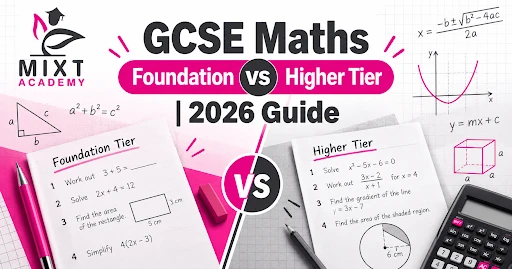
Choosing between Foundation and Higher GCSE maths affects more than just the questions you see in an exam. It sets the grades you can achieve and can influence which courses you can take after Year 11.
Foundation is designed for grades 1 to 5, while Higher opens access to grades 4 to 9, with a narrow grade 3 safety net for students who just missed a grade 4. The right tier depends on current performance, confidence and future requirements, not pride.
This guide compares the papers, explains the risks and offers practical checks to discuss with your school. Mixt Academy supports students with focused online GCSE maths tuition that builds skills around their current level and grade goals.
Foundation vs Higher GCSE Maths: A Quick Comparison
Both tiers lead to the same GCSE maths qualification, but they differ in the content assessed and the grades available. Your choice should reflect what you can achieve and what you need for your next step.
| Feature | Foundation Tier | Higher Tier |
| Available Grades | 1 to 5 | 4 to 9, with a narrow grade 3 safety net in some cases |
| Best Suited To | Students targeting grades 4 or 5 | Students targeting grades 6 to 9 |
| Question Difficulty | Focuses on core and additional foundation content. | Includes Foundation content and more advanced topics |
| Main Benefit | Supports students working towards a secure pass. | Keeps higher GCSE grades within reach |
| Main Risk | You cannot achieve a grade above 5. | You may receive an ungraded result if your marks fall below the required level. |
| Future Study | Suitable for many post-GCSE routes that accept grades 4 or 5. | Usually required for A Level Maths and some maths-related courses |
The key difference is the grade range and the mathematical content each paper covers. Choosing Higher does not automatically lead to a better result. Equally, choosing Foundation does not mean you lack mathematical ability. Your current performance and future plans should guide the decision.
What Do Foundation and Higher GCSE Maths Papers Test
The two tiers assess the same broad areas of mathematics. These include number, algebra, ratio, proportion, geometry, probability and statistics. The difference lies in the range of content and the level of challenge. The foundation focuses on basic and additional foundation content. Higher covers these areas and includes content intended for students working towards the upper GCSE grades.
How the exam content differs
According to the AQA GCSE maths specification, the approximate weighting of each topic differs between the tiers.
| Topic | Foundation Tier | Higher Tier |
| Number | 25% | 15% |
| Algebra | 20% | 30% |
| Ratio, Proportion and Rates of Change | 25% | 20% |
| Geometry and Measures | 15% | 20% |
| Probability and Statistics | 15% | 15% |
These figures show why your strengths matter. The foundation places more emphasis on numbers and ratios, while the higher places more weight on algebra and geometry.
For example, you might confidently calculate percentages, simplify ratios and solve straightforward equations. These skills can help you build marks on foundation papers. Higher students need these foundations too, but they must also tackle more demanding algebra, unfamiliar problems and longer calculations.
At Mixt Academy UK, online GCSE maths tuition can focus on the topics that need the most attention, whether a student is strengthening core skills or preparing for more challenging questions.
How Many Papers Will You Sit on?
For AQA GCSE Maths, students sit three written papers:
- Paper 1: Non-calculator
- Paper 2: Calculator
- Paper 3: Calculator
Each paper lasts 1 hour and 30 minutes and contributes one third of the final assessment. Students must take all three papers at the same tier in the same exam series. Other exam boards may present their specifications differently, so check your own exam board’s requirements before planning revision.
Both tiers also test more than memorised methods. You need to interpret questions, select the correct approach, show working and apply mathematical knowledge to different situations.
What Are the Benefits of Foundation GCSE Maths
Foundation Tier can be a sensible choice when your main goal is to achieve a grade 4 or 5. It allows you to focus on the content assessed at this level instead of spending most of your revision time on topics beyond your current ability.
1. You can concentrate on core skills.
Foundation revision gives you the chance to strengthen essential topics, including:
- Fractions, decimals and percentages.
- Ratio and proportion.
- Basic algebra and equations.
- Angles, area and volume.
- Graphs and coordinates.
- Probability and statistics.
These skills also support everyday tasks such as comparing prices, understanding data and working with measurements.
2. You Can Build Confidence Through Steady Progress
If difficult algebra questions often stop you from completing a paper, working through more accessible questions can help you develop accuracy and confidence. Imagine that you understand percentages but struggle with simultaneous equations.
Foundation revision lets you focus on the percentage questions and other core topics that can help you secure marks. The aim is not to avoid every difficult question. It is to master the material that gives you a realistic route towards your target grade.
3. You Can Work Towards a Pass Without Chasing Unnecessary Content
Students who don’t need a grade above 5 may benefit from focusing on the areas that matter for their chosen qualification. This does not mean Foundation is an easy option. You still need to learn the syllabus, practise exam questions and manage your time under exam conditions.
What Are the Limitations of Foundation GCSE Maths
The biggest limitation is the grade ceiling. The highest grade available on the Foundation Tier is 5, no matter how well you perform. If you need a grade 6, 7, 8 or 9, Foundation cannot meet that target.
This matters when planning your next steps. A sixth form offering A Level Maths may require a higher GCSE grade, often alongside evidence of strong mathematical understanding. Requirements differ between providers, so check the entry criteria for your intended course before deciding.
Foundation also excludes the Higher-only content assessed in the full GCSE specification. Students planning further mathematical study may need to learn these topics later. That does not make Foundation a poor choice. It means the tier should match your intended outcome. A student who needs a grade 4 for their next course may have little reason to pursue higher if their teacher believes the risk outweighs the benefit.
What Are the Benefits of Higher GCSE Maths?
The Higher Tier is for students aiming to achieve grades 6 to 9. It provides access to the full GCSE grade range and assesses more advanced mathematical content.
1. You can aim for grades above 5.
If you are consistently performing around grade 5 or higher and can manage increasingly demanding questions, Higher may be appropriate. The extra grade range can matter when applying for courses with specific entry requirements. Some sixth forms expect grade 7 or above for A Level Maths, although you should always check their published criteria.
2. You can develop advanced mathematical skills.
Higher tiers include topics and question types that demand more complex reasoning. These may include:
- Quadratic equations and expressions.
- Simultaneous equations.
- Algebraic fractions and functions.
- Trigonometry and circle theorems.
- Geometric proof.
- Multi-step problem-solving.
You need more than the ability to remember a formula. You must recognise which method applies, connect different topics and explain your working clearly.
3. You can prepare for further mathematical study.
Higher Tier generally provides better preparation for students planning A Level maths or courses with substantial mathematical content. It gives you the opportunity to practise the advanced GCSE topics that support further study. Still, choosing higher is only the first step. You need consistent revision and a solid understanding of the content to make the most of it.
What Are the Risks of Choosing Higher GCSE Maths
Higher Tier has a broader grade range, but that does not make it the right choice for every student. The main risk is sitting an exam where too much of the content is beyond your current level. If you struggle with algebra, equations, and multi-step problems, you may spend too much time on questions you cannot complete.
This can also affect your confidence. Repeated difficulty with unfamiliar questions may distract you from the more accessible marks you could earn. Higher-tier students who fall just short of grade 4 may receive grade 3 under the permitted safety net. Students who do not reach the required standard for that grade receive a U, meaning ungraded.
Foundation students cannot receive a grade 6 or above, but they can still earn grades 1 to 5. The right choice depends on balancing your grade target with your current ability. Ofqual also states that a grade 4 or 5 is not easier to achieve on one tier than the other. Exam boards must maintain the same standard for these grades across Foundation and Higher.
How Do You Choose the Right GCSE Maths Tier?
Before deciding, consider five practical factors rather than choosing a tier based on what your friends are taking.
1. Review Your Recent Mock Results
Look beyond your overall mark. Check which questions you answered correctly and where you lost marks.
For example, a student scoring around grade 5 may have strong number skills but struggle with harder algebra. Their teacher can assess whether they are ready to progress towards higher or would benefit from consolidating foundation content.
One mock exam should not decide everything. Look for a consistent pattern across several assessments.
2. Check Your Target Grade
Ask yourself what grade you realistically need.
- Grade 4 or 5: Foundation may be suitable.
- Grades 6 to 9: You need a higher tier.
- A Level Maths: Check the sixth form’s entry requirements, which usually call for Higher Tier and a strong GCSE grade.
Set a target that reflects your current ability, the time remaining and the requirements of your next course.
3. Identify Your Strongest and Weakest Topics
These questions reveal whether you have the knowledge needed for higher. If you have gaps in core skills, address them before taking on large amounts of advanced content. If your foundations are secure and you can solve unfamiliar problems, Higher may be worth considering.
- Can you solve linear equations without help?
- Do you understand fractions and ratios?
- Can you apply the correct method when a question combines several topics?
4. Discuss the Decision with Your Maths Teacher
Your teacher can compare your mock results, classwork, topic tests and progress over time. They can also explain what you would need to improve before moving between tiers. Ask specific questions:
- What grade am I working at consistently?
- Which topics are stopping me from progressing?
- What marks am I losing on higher questions?
- How much improvement is realistic before the exam?
- When must the final exam entry be confirmed?
Use this feedback to make a decision based on evidence rather than pressure.
5. Consider the Time Available for Revision
A student with several months to improve may have more opportunity to close gaps than someone choosing a tier shortly before the exam. Look at your current workload and the topics you need to cover. You should have enough time to practise questions, review mistakes and revisit difficult areas. Do not choose Higher simply because it sounds more ambitious. Choose it when your current performance and future goals support that decision.
Can You Switch from Foundation to Higher GCSE Maths
Schools may be able to change a student’s tier before the relevant exam entry deadlines, but don’t leave it until the last minute. Available options depend on the exam centre, exam board procedures, and entry arrangements. If you are considering a change, speak to your maths teacher as soon as possible.
Ask whether your recent assessments support the move and whether there is enough time to study any additional content. If you are a private candidate, discuss the tier with the school or exam centre handling your entry. The aim is to enter the paper that gives you a realistic opportunity to achieve your target grade. Changing tiers without a clear revision plan can create extra pressure rather than improve your result. Students can also explore how to choose GCSE subjects to make informed decisions and improve their chances of achieving better grades.
How Should You Revise for Each Tier
Your revision should reflect the content you will sit in the exam on. Both tiers need regular practice, clear working and a good understanding of basic mathematical methods.
Foundation Tier revision
Prioritise accuracy and familiarity with common question types.
- Practise fractions, decimals, percentages and ratios.
- Review basic algebra and solving equations.
- Work on geometry, measurements, probability and statistics.
- Complete the Foundation past papers under timed conditions.
- Keep a record of mistakes and repeat questions on weak topics.
Start with a topic you find difficult, review the method and answer several questions without looking at the solution.
Higher Tier revision
Build on your core knowledge while giving extra attention to advanced topics.
- Practise quadratics, simultaneous equations and algebraic manipulation.
- Review trigonometry, circle theorems and geometric proof.
- Work through unfamiliar multi-step problems.
- Complete higher past papers and review your mistakes.
- Practise showing each stage of your working clearly.
For both tiers, use past papers from your own exam board. Mark your work against the official mark scheme and learn why each mark was awarded or lost.
Need Support Before Choosing a Tier? Join Mixt Academy UK
Not sure whether ‘Foundation’ or ‘Higher’ matches your current level? Focused GCSE maths tuition can help you identify gaps, practise suitable questions and use mock results to plan your revision. Focusing on the topics you need to improve can make your study time more effective.
Speak with an online maths tutor about your exam board, current working grade and plans after Year 11. A clear revision plan can help you prepare for the right papers and discuss your tier with your school.
Conclusion
Choosing between Foundation and Higher GCSE maths starts with your target grade. Foundation offers grades 1 to 5 and suits many students working towards a secure pass. Higher opens the door to grades 6 to 9 but requires stronger preparation across a wider range of content.
Review your mock results, check your future course requirements and identify the topics you need to improve. Discuss your options with your maths teacher before your exam entry is finalised.
The best tier is not necessarily the one with the highest possible grade. It is the one that matches your current ability, gives you a realistic chance of success and supports your next step in education.
Frequently Asked Questions
Can you get a grade 6 on Foundation GCSE Maths?
No! Foundation Tier offers grades 1 to 5. If you are aiming for grade 6 or above, you must take Higher Tier. Check your current results and your teacher’s assessment before deciding whether the higher paper is a realistic option.
Is Foundation GCSE Maths easier than Higher?
Foundation covers a narrower range of mathematical content and does not include the full higher-only content. Both tiers still require preparation and clear working. Ofqual also confirms that grades 4 and 5 are the same standard across both tiers.
What happens if you fail Higher GCSE Maths?
Students who just miss grade 4 may receive grade 3 under the higher-tier safety net. If they do not reach the minimum standard for grade 3, they receive a U, meaning ungraded. Speak to your teacher if you are concerned about your current performance.
Do you need Higher GCSE Maths for A Level Maths?
A higher tier is generally expected for A Level maths because students need a strong understanding of algebra and other advanced topics. Entry grades vary by sixth form or college. Check the requirements of your intended provider before confirming your GCSE maths tier.
Does Mixt Academy UK offer online GCSE Maths tuition for both tiers?
Mixt Academy UK offers online tutoring for students preparing for GCSE maths. Support can focus on foundation topics, advanced higher content, exam technique and revision planning. The aim is to address individual learning gaps and help students prepare for the papers that match their entry tier.