
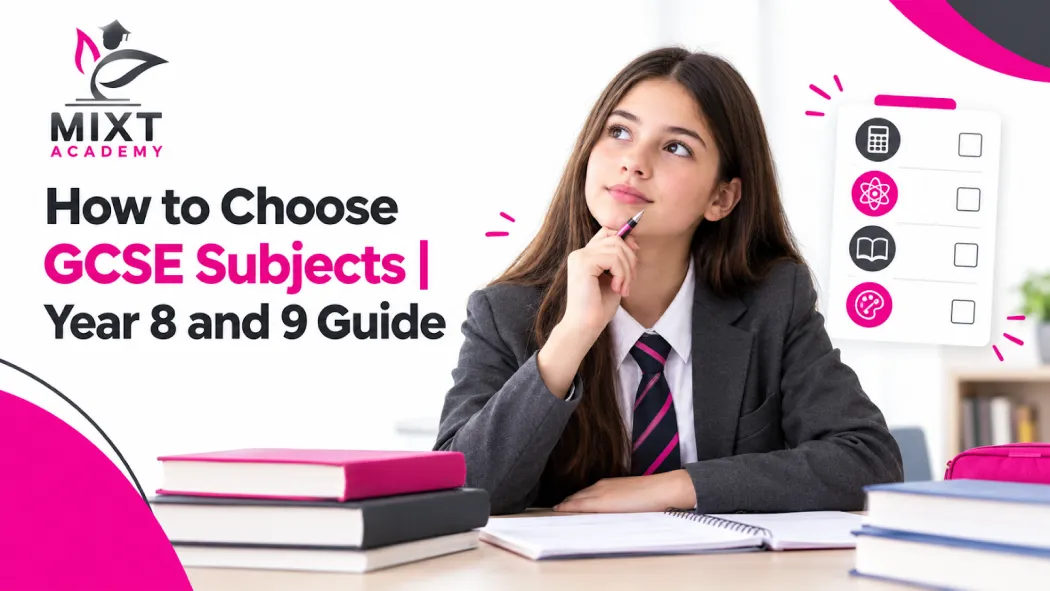
Choosing your GCSE subjects is an important step in your education. If you are in Year 8 or Year 9, you may already be thinking about which subjects to study next. You might have a clear favourite, a career in mind or no idea where to start.
Your choices will shape what you study in Years 10 and 11. They can also affect which A Levels, college courses and career pathways are available later. You do not need to have your entire future planned yet.
This guide explains how to choose GCSE subjects, understand your school’s requirements and make choices that suit your interests, strengths and future plans
GCSE Options Explained: What Parents Need to Know
GCSEs are qualifications that students usually study between the ages of 14 and 16. Most schools ask pupils to choose their options in Year 9, although some begin the process in Year 8. The exact choices depend on the school. Understanding the main subjects at GCSE groups, assessment methods, and entry requirements will help you guide your child without unnecessary pressure.
When Does Your Child Choose Their GCSE Options
Most students choose their GCSE subjects in Year 9, usually before Year 10 starts. Some schools ask pupils to choose in Year 8 because their GCSE programme begins earlier. Here is what the usual timeline looks like.
| School Year | Typical Age | What Happens |
| Year 8 | 12 to 13 | Some schools start students exploring GCSE subjects. |
| Year 9 | 13 to 14 | Most schools hold options evenings and collect subject choices. |
| Year 10 | 14 to 15 | GCSE courses begin, and students study their chosen subjects. |
| Year 11 | 15 to 16 | Students prepare for final assessments, usually held in May and June. |
| After Year 11 | 16 | Students progress to sixth form, college, an apprenticeship or another suitable pathway. |
Ask your child’s school for its options booklet and submission deadline. This will help you understand the available subjects, any compulsory choices and which subjects can be taken together.
How Many GCSEs Should Your Child Take
Most students take around eight to ten GCSEs, though the number varies by school. No single national GCSE total applies to every student. A typical combination includes:
- Core subjects such as English Language, Maths and Science.
- Additional subjects required or offered by the school.
- Optional subjects chosen according to the student’s interests and future plans.
Some schools allow pupils to take more subjects, while others use a more restricted timetable. Taking extra GCSEs does not automatically improve a student’s prospects. Strong grades in relevant subjects can be more useful than taking on an excessive workload. Our online GCSE tutors can help students manage their studies and prepare for exams. The aim is to choose a manageable combination that gives your child enough time to understand the content, practise exam questions and prepare properly.
Which GCSE Subjects Are Compulsory
In England, English, mathematics and science are core subjects within the national curriculum at Key Stage 4. Schools must also account for other curriculum requirements including Computing, Citizenship and Physical Education. Religious education must be provided as well, although the precise arrangements depend on the type of school.
A subject being part of the curriculum does not automatically mean every pupil must take a separate GCSE qualification in it. In practice, students generally take GCSE English Language, Mathematics and a science qualification. Many schools also enter pupils for English literature, but policies vary by school.
PE, Computing, Citizenship and Religious Education may be taught without every student taking a GCSE in each subject. Check your school’s options booklet to establish which subjects are compulsory, which lead to qualifications and which are optional.
The National Curriculum guidance for Key Stage 3 and 4 explains curriculum requirements for schools in England.
Combined Science or Triple Science
Every student studies biology, chemistry and physics as part of their science education, but the GCSE route can differ.
| Science route | What It Involves | Who Might Prefer It? |
| Combined Science | Covers Biology, Chemistry and Physics and normally awards two GCSE grades through one double-award qualification. | Students who want a broad science education alongside other options. |
| Triple Science | Offers three separate GCSE qualifications in Biology, Chemistry and Physics, with more content than Combined Science. | Students who enjoy science or are considering science-related A Levels. |
Both routes can lead to further study in science. Triple Science can provide a useful foundation for students considering subjects such as biology, chemistry, or physics at A Level, but it is not required for every science-related degree. Your school will explain whether Triple Science is part of the core timetable or takes up an optional subject slot.
For further clarification, see Ofqual’s explanation of GCSE science grading.
The Complete GCSE Options List: Subjects and What They Involve
Schools cannot offer every GCSE subject available nationally. The following list covers the main options your child may encounter, with examples of what each subject involves.
1. English and Mathematics
These subjects develop skills that students use throughout their education.
- English Language: Reading, analysing texts, understanding language and writing for different purposes.
- English Literature: Studying poetry, novels, plays and other literary texts.
- Mathematics: Algebra, geometry, number, probability, statistics and problem solving.
- Statistics: Collecting, presenting and interpreting data, where offered as a separate GCSE.
Maths and English are useful for almost every further education pathway. Many schools enter students for both English Language and English Literature, but English Literature arrangements vary between schools. Check the school’s requirements carefully rather than assuming literature is either universally compulsory or entirely optional.
2. Science Subjects
Science GCSEs help students understand the natural world and develop analytical skills.
- Biology: Cells, genetics, ecology, human physiology and living organisms.
- Chemistry: Atoms, chemical reactions, bonding, rates of reaction and the properties of substances.
- Physics: Forces, energy, electricity, waves, magnetism and space.
- Combined Science: Combines Biology, Chemistry and Physics into a two-GCSE qualification.
Students who enjoy experiments, scientific explanations, and problem-solving may want to explore these subjects in greater depth.
3. Humanities and Religious Studies
Humanities subjects develop research, interpretation and evidence-based reasoning.
- History: Investigating past events, analysing historical sources and explaining change over time.
- Geography: Studying physical environments, populations, economies, climate and global issues.
- Religious Studies: Exploring religious beliefs, moral questions, ethical decisions and different worldviews.
- Ancient History or Classical Civilisation: Studying ancient societies, historical evidence, literature and culture, where available.
History often involves extended written answers. Geography combines written analysis with geographical data and knowledge of fieldwork. Religious Studies suits students who enjoy considering different viewpoints and explaining arguments.
4. Languages
Language GCSEs develop speaking, listening, reading and writing skills. Common options include:
- French
- Spanish
- German
- Arabic
- Mandarin Chinese
- Italian
- Urdu
- Polish
- Panjabi
Other languages may be available depending on the exam board and school. A student who already speaks a language at home may wish to ask whether their school can support them in taking the qualification. Availability and entry arrangements should be confirmed before making plans.
5. Business and Social Sciences
These subjects explore how people, organisations and society work.
- Business: Marketing, finance, operations, business growth and decision-making.
- Economics: Markets, employment, prices, inflation and how economies operate.
- Psychology: Human behaviour, memory, development and psychological research.
- Sociology: Families, education, crime, social groups and inequalities.
- Citizenship Studies: Rights, democracy, the legal system and participation in society.
These subjects may appeal to students interested in business, finance, human behaviour or social issues. Some are introduced for the first time at GCSE, so your child should read the course description rather than relying only on what the subject name suggests.
6. Computer Science and Technical Subjects
Technical GCSEs help students explore digital systems, design, and practical problem-solving.
- Computer Science: Programming, algorithms, data representation and computer systems.
- Design and Technology: Designing products, choosing materials and developing solutions to practical problems.
- Engineering: Exploring engineering principles, materials and design, where available.
- Electronics: Understanding circuits, electronic components and systems, where offered.
- Food Preparation and Nutrition: Cooking techniques, food safety, nutrition and the science of food.
Computer Science is different from simply using computers. Students usually need to understand logical thinking and how computer programs work. Design and Technology and Food Preparation and Nutrition can include practical projects alongside written examinations. Check the relevant specification to understand the assessment requirements.
Note for Parents: Computer Science is a current GCSE option, but the government has announced plans for a broader Computing GCSE in the future. The planned changes are explained in the GCSE reforms section below.
7. Creative and Performing Arts
Creative subjects let students develop practical skills, create original work and evaluate their decisions.
- Art and Design: Developing ideas through drawing, painting, photography, textiles, graphics or three-dimensional design.
- Drama: Exploring scripts, acting, performance and theatre techniques.
- Music: Performing, composing and listening to music.
- Dance: Developing performance and choreography skills.
- Media Studies: Analysing media products and understanding how media messages are created.
- Film Studies: Exploring film language, storytelling, themes and cinematic techniques.
These subjects are not necessarily easier alternatives to academic GCSEs. Some demand substantial independent work, practical preparation or portfolio development. If your child enjoys creative activities, ask how much work happens outside lessons and which parts of the assessment count towards the final grade.
8. Physical Education and Other Specialist Subjects
Physical Education explores sports performance and the theory behind physical activity. GCSE assessment may include written examinations and practical performance.
Depending on the school and exam board, students may also encounter specialist subjects such as astronomy, classical Greek, Latin or geology. These less widely available options can be worth investigating if they match your child’s interests.
Confirm that the school actually offers the qualification before including it in the options plan. Remember that studying PE as part of the school curriculum is different from taking GCSE Physical Education as an examined qualification.
GCSE Exam Boards and Assessment Methods Explained
GCSE exam boards develop specifications and assessments for individual subjects. In England, the main awarding organisations offering GCSEs include AQA, Pearson, OCR and WJEC Eduqas.
Your child does not normally choose the exam board. Their school selects one for each subject. The exam board matters because it determines the detailed course content, set texts where applicable and exam format. Once your child starts a GCSE course, they should use revision materials that match the specification their school teaches.
Ofqual regulates GCSE qualifications in England. Its GCSE requirements and guidance collection provide information about regulated qualifications and their subject requirements.
How Are GCSE Subjects Assessed
Not every GCSE follows the same assessment structure.
| Assessment type | What students do | Examples |
| Written examinations | Answer questions under timed conditions. | Maths, English and many humanities subjects. |
| Practical assessment | Demonstrate a skill or complete practical work. | Dance, drama and some PE courses. |
| Coursework or non-exam assessment | Complete projects or produce assessed work during the course. | Art and design, music and some technical subjects. |
| Mixed assessment | Complete examinations alongside practical or project work. | Design and Technology and Food Preparation and Nutrition. |
The proportions vary by subject and specification. Do not assume a creative subject has no written examination or that a technical subject is mostly practical. Look at the specification with your child and ask the subject teacher to explain the workload before submitting the options form.
What Is Changing About GCSE Options
Education policy in England is changing following the government’s response to the Curriculum and Assessment Review. Its plans cover curriculum content, qualifications and the range of options available to students.
According to the government’s response to the Curriculum and Assessment Review, the revised national curriculum is expected to be published in 2027, with teaching beginning in September 2028. Reformed GCSEs are planned for phased introduction, with the first subjects expected to be taught from September 2029 and further subjects from September 2030.
The government has also announced plans to replace the existing computer science GCSE with a broader computing GCSE. The proposed qualification is intended to cover a wider range of computing and digital skills while retaining important computer science principles, including programming and algorithms.
The government has also committed to strengthening the Triple Science offer and working towards a statutory entitlement for eligible pupils. The Department is still developing the practical arrangements and implementation of this entitlement.
On 23 September 2026, the Department for Education announced new Vocational GCSEs intended to sit alongside traditional GCSEs and eventually replace existing Technical Awards. Some subjects may become available from September 2029. The announcement mentioned possible subject areas, including business management and finance, creative media production, digital tech, child development, and building & construction.
These changes will be introduced over time. Not every proposed subject will necessarily be available at every school immediately, and examples of potential vocational subjects should not be treated as a final list.
For families choosing options now, use the subjects and specifications confirmed by your child’s school. Monitor official government announcements for updates rather than making decisions based on proposed qualifications that may not yet be available.
What If Your Child’s School Does Not Offer Their Preferred GCSE
A school may not offer every subject, particularly specialist languages or less common courses. If your child wants to study an unavailable GCSE, speak to the school’s exams officer or careers adviser before making alternative arrangements.
In some cases, students can study independently and enter an examination as a private candidate at an approved centre. However, an exam centre must agree to accept the entry; not every school, college or centre accepts private candidates.
The process depends on the qualification, the awarding organisation and the assessment requirements. Subjects involving practical work or non-exam assessments can be harder to arrange independently because the centre must support the required assessment components.
Before committing to a subject, confirm that a suitable centre can accept the entry, administer the required assessments and meet the qualification’s requirements. Check the fees, deadlines and arrangements for any coursework or practical components as well.
The Ofqual student guide to exams and assessments explains how private candidates register. You can also consult the Joint Council for Qualifications’ private candidate guidance. Create an effective GCSE revision timetable for exam preparation.
How to Help Your Child Choose Their GCSE Options
Parents can help children make sound decisions without choosing every subject for them. The aim is to understand what suits the student and what they may need later.
1. Start With Their Interests and Strengths
Ask which lessons they enjoy and what they find satisfying about them. Then compare these preferences with their current strengths. A student who enjoys researching past events may prefer history.
Someone who likes creating designs may enjoy art and design. A pupil who enjoys logical problems may want to investigate computer science. Current grades matter, but they should not be the only deciding factor.
2. Check Future Course Requirements
If your child has a possible career or A Level subject in mind, research the entry requirements before finalising their options. For example, a student considering A Level Chemistry should check whether their intended sixth form requires a particular GCSE Chemistry or Combined Science grade.
Requirements vary between schools and colleges, so do not assume one rule applies everywhere. If your child has no clear career plans, that is normal. Focus on a balanced choice that keeps several suitable pathways open.
3. Consider Workload and Assessment
Some subjects require regular written practice, while others involve practical projects or substantial independent work. Read the specification and ask teachers what students find challenging. This gives your child a more realistic picture of what two years of study will look like.
4. Attend the School’s Options Evening
Options evenings let families speak directly with subject teachers. Ask about course content, assessment methods and the skills students need to succeed. You can also ask whether particular subjects clash in the timetable and whether any combinations are recommended for future courses.
5. Avoid Choosing for the Wrong Reasons
Encourage your child to choose subjects based on their interests and goals, rather than following friends or picking a course because it sounds easy. Your role is to help them understand the choices, ask useful questions and make a decision they feel prepared to work towards.
How Mixt Academy UK Can Support Your Child in GCSE
Subjects in GCSE choices are easier to manage when students understand their strengths and feel prepared for the next stage. Mixt Academy UK provides GCSE’s online academic support to help students build subject knowledge, improve study habits and approach challenging topics with confidence.
A suitable tutor can help your child explore unfamiliar subjects, strengthen core skills and prepare for GCSE learning. Discuss your child’s needs together and explore the support that fits their goals.
Helping Your Child Make the Right GCSE Choices
Choosing GCSE options does not require your child to have their future mapped out. It requires thoughtful decisions based on their interests, abilities, school requirements and possible next steps.
Start by reviewing the options booklet, comparing subjects and checking any relevant sixth form entry criteria. Give your child time to ask questions and consider different assessment styles before making a final decision.
A balanced, manageable combination can support strong learning habits and leave room for future choices. With clear information and guidance from teachers, your child can approach their GCSE years with greater confidence.
Frequently Asked Questions
What are the best GCSE subjects to choose?
The best GCSE subjects suit your child’s interests, strengths and future plans. If they are unsure about their career, a balanced selection of academic, creative, technical or language subjects can help keep options open. They should also check their school’s requirements and any entry criteria for future courses.
Can my child take a GCSE subject that their school does not offer?
Possibly, some students study independently and sit examinations as private candidates at approved centres. However, the centre must accept the entry, and subjects with practical assessments or non-exam assessments may be harder to arrange. Confirm availability, costs and assessment arrangements before starting.
Is English literature compulsory at GCSE?
English literature is widely taught, and many schools require students to take both English language and English literature. However, school policies differ. Parents should check their school’s curriculum and exam-entry requirements rather than assuming English Literature is compulsory in every case.
Which GCSE subjects are best for getting into university?
No single GCSE combination is required for every university course. English, mathematics and science are important foundations, while other subject requirements depend on the course and the sixth form or college pathway. Check specific entry criteria early, particularly if your child is considering a subject with prerequisites.
Can students change their GCSE options after choosing them?
Some schools allow changes before courses begin or during the early weeks of Year 10. Approval depends on school policy, timetable space and how much course content the student has missed. Contact the school as soon as concerns arise.