
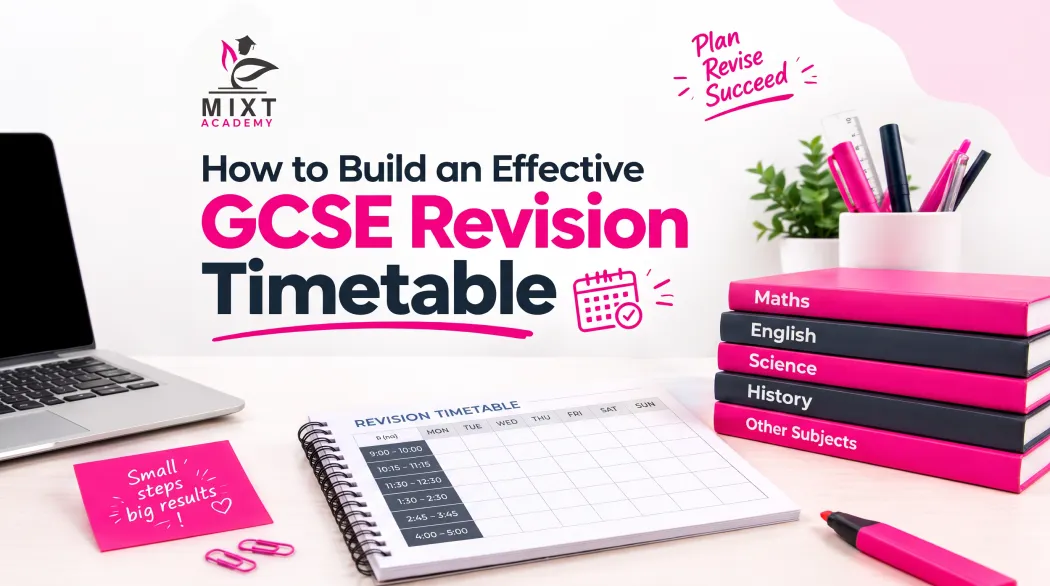
Add homework, mock exams, hobbies, and family commitments, and deciding what to study next can become a challenge. A sensible revision timetable gives each subject a place in your week without expecting you to study every free minute. The aim is not to create the most packed schedule possible but to build one that you can follow consistently and change when circumstances shift.
Start Planning Before Revision Becomes Urgent
There is no single perfect date for every student to begin planning. A useful starting point is several weeks before intensive exam preparation, particularly once mock results or teacher feedback show which subjects need extra attention.
Begin by writing down every GCSE subject and the major topics included in each one. Then add fixed commitments such as lessons, sports training, part-time work, music, clubs, family events, and planned holidays.
Your gcse revision timetable should also include exam dates rather than treating revision as something separate from your exam schedule. A clear gcse calendar can help you see which papers are coming first and prevent you from spending too much time on an exam that is still several weeks away.
Turn Subjects into Specific Study Tasks
Writing “revise Biology” or “do History” on a timetable is too vague. A better approach is to give each session a defined outcome.
For example, instead of setting aside an hour for Maths, you could focus on simultaneous equations, complete ten practice questions, and review any errors. For English Literature, a session might involve analysing one character, testing your recall of key quotations, and writing a short paragraph.
This makes a revising timetable easier to follow because you know exactly what needs to happen when you sit down. It also makes progress easier to notice. Completing a specific task provides a clearer sense of achievement than simply spending sixty minutes with a textbook open.
Give More Time to the Subjects That Need It
Equal time does not always mean fair time. A student who feels confident with online GCSE Maths tutor may not need the same number of sessions as someone struggling with algebra, for example. Start by identifying three categories, including:
- Subjects you understand well
- Topics that need regular practice
- Areas where making mistakes repeatedly
Give the largest share of your study time to the third category, while still revisiting stronger areas so they do not become rusty. Keep the balance moving too. After a few weeks, a difficult topic may become much more secure, while another subject may need additional attention after a mock result. A useful GCSE timetable plan therefore needs to respond to evidence rather than staying unchanged from the day it was written.
Plan Around Your Energy, Not Just the Clock
A two-hour study block may look productive on paper but become ineffective if you are exhausted after school. For many students, shorter sessions work better on weekdays, while weekends provide room for longer blocks. You might schedule 30 to 45 minutes after school for a demanding subject, take a proper break, and then complete a lighter task. At weekends, you could use longer sessions for past papers while leaving part of the day free for sport, friends, gaming, or simply resting.
Breaks should be planned rather than treated as a reward for finishing everything. Sleep, meals, movement, and downtime all matter because revision is much harder to sustain when the schedule leaves no space to recover. Your plan should also contain spare time. A surprise homework deadline, school event, illness, or difficult topic can disrupt even a carefully organised week.
Build Revision Techniques into Each Session
Planning tells you when to study, but the quality of each session depends on what you do during it. Avoid filling the timetable with tasks that only involve rereading notes. Use a mixture of activities depending on the subject. You might test yourself without looking at your notes, answer exam questions under timed conditions, explain a difficult idea aloud, or revisit mistakes from an earlier paper.
Past papers become especially useful as exams approach because they show whether you can apply knowledge under exam conditions. Marking them carefully can reveal patterns, such as losing marks because of weak calculations, incomplete explanations, or misunderstanding command words. Students who need additional academic support may also explore reputable tuition options such as Mixt Academy, including guidance from online gcse tutors when independent study is not enough.
Review and Adjust the Plan Each Week
A good revision plan should guide your preparation, not restrict it. Set aside a few minutes each week to review what you completed, identify missed sessions, and note any topics that still feel uncertain. This simple check helps you keep your schedule realistic and make changes before small problems become bigger gaps.
| What to Review | What to Do Next |
|---|---|
| Missed Sessions | Move unfinished tasks to a realistic spare slot rather than overloading the next day. |
| Difficult Topics | Add extra practice for subjects or topics where you are still making mistakes. |
| Stronger Areas | Reduce their frequency slightly while keeping occasional revision to maintain recall. |
| Approaching Exams | Gradually shift from learning content towards past papers, timed questions, and error correction. |
| School Commitments | Adjust revision around mocks, homework, coursework deadlines, activities, and other fixed responsibilities. |
| Need for Support | Consider help from qualified GCSE tutors in UK settings when a particular subject or exam skill needs additional guidance. |
Parents can help by protecting study time, encouraging regular breaks, and allowing students to take ownership of their schedule. A flexible study plan is far more sustainable than one that leaves no room for real life.
Common GCSE Revision Planning Mistakes
A revision plan can look impressively organised and still fail to improve your results. The real problem is usually not a lack of effort but a schedule that is too demanding, too comfortable, or focused on activity rather than actual learning.
- Creating Unrealistic Schedules: Overloading each day can quickly cause fatigue and lost concentration.
- The Solution: Use shorter, focused sessions with regular breaks.
- Choosing Familiar Topics: Revising only comfortable subjects leaves important gaps.
- The Solution: Prioritise weaker areas using mock results, classwork, and practice scores.
- Relying On Rereading: Repeatedly reading notes does not prove you can recall information.
- The Solution: Use active recall, flashcards, self-testing, and exam questions.
- Counting Study Hours: Long hours do not always equal effective learning.
- The Solution: Track completed tasks, corrected mistakes, and practice questions.
- Delaying Revision Plans: Starting too late creates unnecessary pressure.
- The Solution: Establish a consistent routine early, with support from a trusted online tutoring platform such as Mixt Academy, which connects students with qualified tutors when additional academic guidance is needed.
- Ignoring Real Commitments: Plans without flexibility are difficult to maintain.
- The Solution: Schedule schoolwork, activities, rest, and spare time alongside revision and go for 1-on-1 tutoring support who offer flexible sessions.
Conclusion
An effective GCSE revision plan should give your week direction without controlling every minute of it. Start early enough to understand your workload, divide subjects into clear tasks, prioritise weaker areas, and leave realistic space for school, rest, hobbies, and unexpected changes.
As your exams approach, review the schedule and adjust your focus based on practice papers, mock results, and the topics you still find difficult. The strongest plan is not the one that looks perfect on paper. It is the one you can use consistently, learn from, and adapt as your GCSE preparation develops.
FAQs
Should I revise every GCSE subject every week?
Not necessarily! Give regular attention to all subjects over time, but allocate more sessions to upcoming exams or areas where you need greater improvement.
What should I do when I keep falling behind my timetable?
First, identify why sessions are being missed. Your schedule may simply be too ambitious. Reduce the workload, keep essential tasks, and rebuild the week around what is realistically achievable.
Is it better to revise in the morning or evening?
That depends on when you are most alert. Some students work better before school, while others concentrate more effectively after a break in the evening.
How can parents help without adding pressure?
Parents can help by providing a quiet study environment, respecting planned breaks, and discussing progress calmly. Encouraging consistency is usually more helpful than monitoring every individual session.