
For most students, the words “mock exam” bring on a mix of nerves and confusion. Are mocks something to stress over or just a formality before the real thing? The truth sits somewhere in the middle. Mock exams are not the final judgement on your ability, but they are one of the most useful tools you have for understanding exactly where you stand before your actual GCSE or A Level papers.
This guide walks through everything that matters when it comes to mock test preparation: how much to revise, how to approach the exams themselves, and what to do with your results once they land. Whether you are working through revision alone, with a parent checking in, or alongside support from UK online tutors, the goal is the same.
Treat your mocks seriously enough to learn from them, without letting them consume every ounce of your energy. At Mixt Academy UK, we see this balance play out with students every year, and getting it right often makes the biggest difference to final exam performance.
What Exactly Are Mock Exams For
A mock exam is a rehearsal. Schools design them to mirror the format, timing, and difficulty of your real papers as closely as possible, usually building them from past exam board questions. The point is not to catch you out. It is to give you an honest snapshot of your current knowledge while there is still time to act on it. Mocks typically serve several purposes at once:
- They let you experience real exam conditions before the stakes are highest
- They reveal gaps in subject knowledge that classroom work alone might not show
- They test whether your exam technique, such as time allocation and question interpretation, actually holds up under pressure
- They feed into predicted grades, which matter for sixth form, college, and university applications
That last point is worth sitting with. Mock results may contribute to predicted grades, although schools and colleges use different processes and can consider a wider range of academic evidence. Mocks might not count towards your final grade directly, but their influence stretches further than many students realise.

Consult with one of our 1,000+ qualified tutors.
How Much Should You Revise Before Mocks
This is where students tend to go wrong in one of two directions. Some barely open a textbook, assuming mocks do not matter. Others throw everything at their mocks, burn out weeks before the real exams even begin, and have nothing left in reserve.
The better approach sits in between. You want to revise enough to get a genuinely accurate picture of your ability, not an inflated one built on last-minute cramming, and not a deflated one caused by doing nothing at all. A rough guide for timing your revision:
- Autumn Term Mocks (November or December): Begin focused revision around three to four weeks beforehand
- Spring Term Mocks (February or March): As a practical starting point, consider beginning focused revision around four to six weeks beforehand.
- Year 12 Summer Mocks: Aim for three to five weeks of preparation
These are starting points, not fixed rules. A student juggling several subjects with heavy content, such as combined science or history, may need to start earlier than someone sitting fewer papers.
Building a Mock Exam Revision Plan for UK Students
A structured revision plan can make mock exam preparation more manageable, especially when students are balancing several subjects. The goal is not to study every topic at once but to prioritise weak areas, use effective revision techniques, and create enough time for practice and rest.
Start With the Specification, Not the Textbook
Before drawing up a timetable, check your exam board’s specification for each subject. This document lists every topic that could appear, and it stops you from wasting time on content that was never going to be tested or missing something important because it was not covered in class notes.
Break Subjects Into Manageable Topics
Once you know what needs covering, split each subject into smaller sections rather than vague blocks like “revise Chemistry”. A plan built around specific topics, such as “rates of reaction” or “the Cold War 1945 to 1963”, is far easier to act on than a general intention to study more.
Mix Different Revision Techniques
Using the same revision method repeatedly can make study sessions less effective. Combining active techniques allows you to test your understanding while improving memory and exam technique.
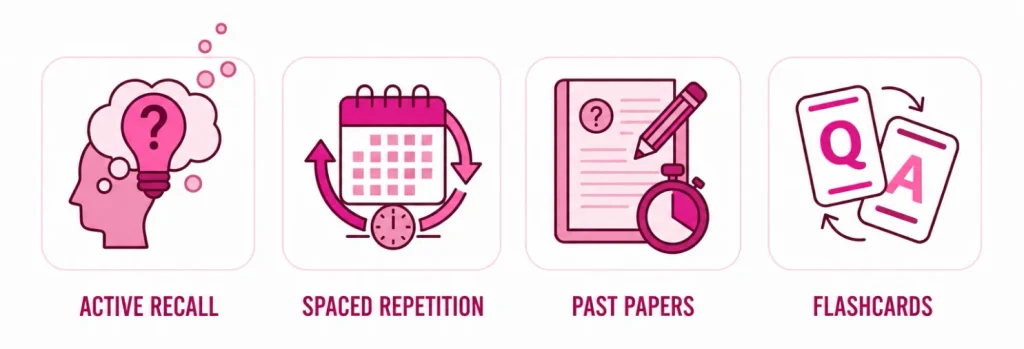
- Active Recall: Test yourself on a topic before checking your notes to identify what you genuinely remember.
- Spaced Repetition: Revisit important topics at planned intervals instead of trying to learn everything in one sitting.
- Past papers: Practise exam questions regularly to improve subject knowledge, timing, and familiarity with question formats.
- Flashcards: Use short question and answer prompts to revise formulas, definitions, key terms, dates, and quotations.
Protect Time for Rest
A revision timetable that leaves no room for breaks, sleep, or activities you enjoy is not sustainable. Build in downtime deliberately rather than treating it as an afterthought. Students who protect their wellbeing during mock season tend to perform more consistently, both in the mocks and in the real exams that follow.
The Day Before Your Mock Exam
What you do in the final twenty-four hours matters more than most students expect.
Worth doing:
- A light review session of no more than an hour, focused on summaries rather than new material
- Laying out your equipment the night before, including calculators, pens, and any permitted resources
- Eating a proper meal and getting close to eight or nine hours of sleep
- Doing something calming in the evening rather than revising until bedtime
Best avoided:
- Cramming unfamiliar topics you have not properly covered
- Staying up late to fit in “one more” revision session
- Excessive caffeine, which can worsen anxiety and disrupt sleep
- Comparing your preparation with what others in your year are doing
How to Approach Your Mock Exam
Good exam technique is a skill you build through practice, and mock exams are the ideal opportunity to sharpen your time management, question analysis, and exam confidence before your final GCSE or A-Level or other qualification papers.
Read the Whole Paper First
Before writing anything, check how many questions there are, whether any choices are offered, and how the marks are distributed. Taking a moment to understand the paper can prevent surprises and help you plan your time effectively.
Read Each Question Twice
Command words like “explain”, “evaluate”, and “compare” ask for different things. Misreading a question is one of the most common and avoidable ways students lose marks in both mocks and real exams.
Allocate Time Based on Marks
Check the total marks and usable exam time to estimate roughly how much time each section deserves. Higher-mark questions should generally receive more of your time, while leaving a few minutes at the end for checking where possible.
Answer What You Know First
Starting with questions you understand well can help you settle into the paper, secure marks early, and build confidence. You can then return to more challenging questions with enough time to think through your answers.
Pause If You Start to Panic
When your mind goes blank, pause for a few seconds, take a steady breath, and refocus on the question. Mock exams provide a useful opportunity to practise managing exam stress and recovering calmly when something feels difficult.
What to Do Immediately After a Mock Exam
Resist the urge to pick apart every answer with friends the moment you leave the room. Discussing specific answers in detail, especially before results come back, tends to fuel anxiety rather than useful reflection. Give yourself time to move on, wait for your results, and use the feedback to identify what you can improve.
- Jot down a quick note of anything you felt unsure about while it is still fresh
- Rest properly if you have another mock coming up
- Avoid searching for answers online straight away, which rarely gives an accurate sense of how you actually did
Making Sense of Your Mock Exam Results
The grade on the front page tells you far less than the marked script itself. This is the stage where real improvement happens, yet it is the one most students skip.
Go Through the Mark Scheme Properly
Look at exactly where marks were lost, not just the total. A single topic causing repeated errors across a paper is a far more useful discovery than a vague sense of “I didn’t do well.”
Sort Your Mistakes Into Categories
Most errors fall into a handful of types:
- Knowledge gaps, where you simply did not know the content
- Misreading or misunderstanding the question
- Technique issues, such as poor structure or running out of time
- Careless mistakes, made despite understanding the material
Knowing which category dominates your results tells you exactly what to fix. A student losing marks to technique needs more timed practice papers. A student with knowledge gaps needs to revisit content directly. Students can prepare for all GCSE exam boards in the UK.
Build a Focused Action Plan
Pick two or three priorities per subject rather than trying to fix everything at once. Make each one specific and measurable, for example, “complete ten practice questions on quadratic equations by next week”, rather than a vague aim like “get better at Maths”. Check in on progress every week or two, and adjust the plan if something is not working.
Using Mocks to Strengthen Your Final Exam Performance
The real value of a mock exam is not the grade itself; it is what you change afterwards. Students who take their mocks seriously tend to walk into their final exams with fewer surprises and far more confidence, and that difference is often visible in the results themselves. If your results were disappointing, a few strategies can help turn things around:
- Speak to Your Teachers: They can offer context on how you compare to expected standards and where they think your energy is best spent
- Consider Extra Support: A tutor can target specific weak areas far more efficiently than general revision alone, and many students find that focused one-to-one sessions close gaps that classroom time cannot
- Use Your Remaining Months Wisely: Between mocks and the real exams, there is usually a window of three to five months, which is enough time to make a meaningful difference if used consistently
- Look After Your Mental Health: A disappointing mock result is a snapshot, not a verdict on your ability or your future
This is also where the right kind of support matters. Families searching for private tuition in London or further afield often turn to tutors specifically after mock results come in, when it is clear exactly which topics or skills need attention.
Mixt Academy UK works with students at this stage regularly, building revision plans around real mock exam data rather than generic study advice, so that time between mocks and finals is spent where it actually counts.
Worried About Your Child’s Grades?
Give give them personalised support from qualified UK tutors who make learning easier and more enjoyable.8 Common Mock Exam Mistakes to Avoid
Mock exams are designed to reveal how prepared you really are before the pressure of final GCSE or IGCSE exams begins. From poor revision techniques and exam stress to weak time management and neglected topics, small mistakes can affect both confidence and performance. Recognising these habits early helps students build better study routines and improve their exam technique.
- Taking Mocks Too Lightly: Treating mock exams as unimportant because they may not count towards final grades can mean missing a valuable chance to identify knowledge gaps and build exam confidence.
- Over Revising Before Mocks: Studying for excessive hours without enough rest can increase exam stress, reduce concentration and make GCSE revision less effective.
- Ignoring Weaker Subjects: Spending most revision time on favourite subjects can leave important topics underprepared and allow weaknesses to carry into final exams.
- Using Passive Revision Methods: Simply rereading notes may create a false sense of preparation, while active recall, practice questions and timed papers can strengthen understanding.
- Avoiding Past Papers: Being afraid of getting questions wrong can stop students from developing proper exam technique and becoming familiar with real exam formats.
- Cramming the Night Before: Last-minute revision often causes unnecessary stress and can leave students tired, distracted and less focused during the mock exam.
- Ignoring Clear Knowledge Gaps: When mock results reveal difficult topics or recurring mistakes, students should use teacher support or UK online tutors to address those areas before final exams.
- Comparing Results with Classmates: Focusing too much on other students’ marks can increase pressure, while tracking personal progress gives a clearer picture of where further revision is needed.
Tutor insight – A Level Online Tutor: Students often focus only on questions they got completely wrong. We also review answers that earned some—but not all—marks, because these frequently reveal exam-technique problems rather than missing knowledge.
Ready to Turn Your Mock Results Into Real Progress
If your mock exams highlighted areas you would like support with, Mixt Academy UK can help you build a focused plan for the months ahead. Our online GCSE tutors work with students across subjects and exam boards, turning mock feedback into targeted, practical revision so nothing important gets left until the last minute. Get in touch to find a tutor who fits your needs and start preparing with real direction.
Final Thoughts
Mock exams are a rehearsal, not a verdict. Approached properly, with genuine revision, honest reflection on results, and a clear plan for what comes next, they become one of the most valuable stretches of the entire exam calendar.
Students who take their mocks seriously tend to walk into their final exams with fewer surprises and far more confidence, and that difference is often visible in the results themselves. Mixt Academy UK has seen this pattern repeat year after year, and it consistently comes down to how mocks are used, not just how they go.
We Answer Every Question of Parents
Are mock exams as hard as the real GCSE or A-level exams?
Schools often use past-paper or exam-board-style questions for mocks so they can provide useful practice under realistic conditions. However, the exact difficulty and grade boundaries may differ from the final examination.
Do mock exam results affect my final GCSE or A-level grade?
Not directly! Mocks do not normally contribute directly to your final GCSE or A-level grade. However, schools may retain evidence from assessments such as mocks under Ofqual’s contingency arrangements in the unlikely event that national exams cannot go ahead.
What if I do badly in my mocks?
A poor mock result is disappointing but rarely permanent. There is usually still plenty of time before the real exams to close gaps, particularly with a focused plan and, where needed, extra support from a teacher or tutor.
How many hours a day should I revise for mocks?
There is no single correct number, since it depends on how many subjects you are sitting and how you personally retain information best. Shorter, focused sessions with regular breaks tend to work better than long unstructured stretches of revision.
Can tutors help with mock exam preparation specifically?
Yes, tutors can help interpret mock results, identify exactly which topics or skills need attention, and build a targeted plan for the months between mocks and final exams, which is often more efficient than general revision alone.