
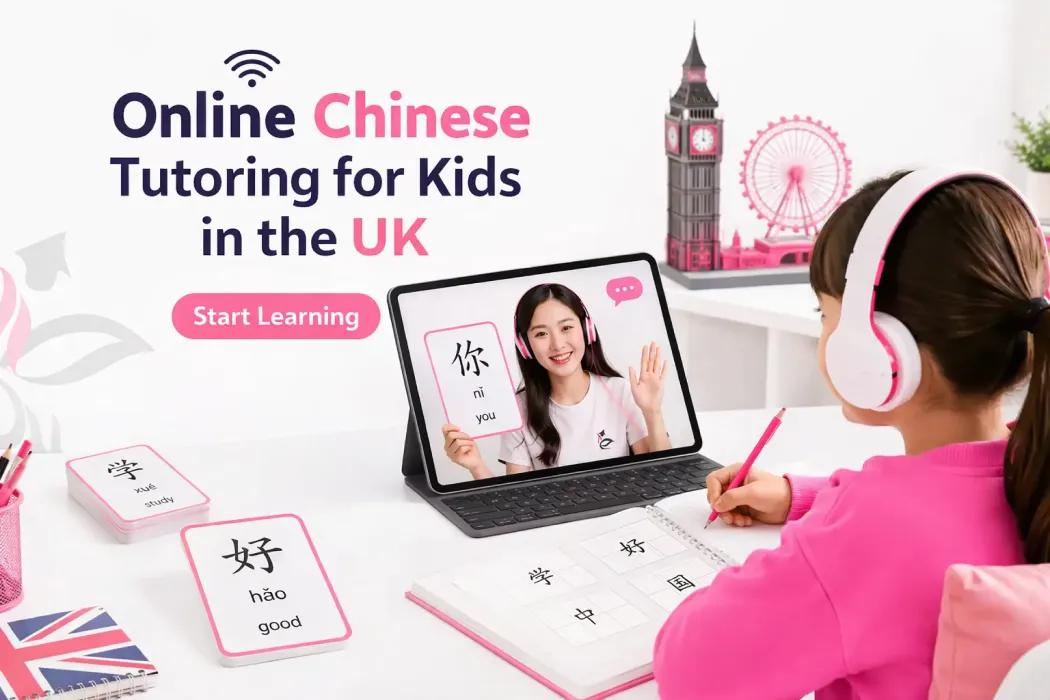
Online Chinese tutoring can help a child develop practical speaking, listening, reading and writing skills without travelling to a tuition centre. The best programme is not simply the one with the most fluent tutor. It is the one that matches your child’s age, current level and reason for learning.
Before booking lessons, decide whether your child needs Mandarin or Cantonese, Simplified or Traditional Chinese, and general language learning or exam preparation. This guide explains each choice and gives UK parents a practical checklist for comparing tutors.
What Is Online Chinese Tutoring?
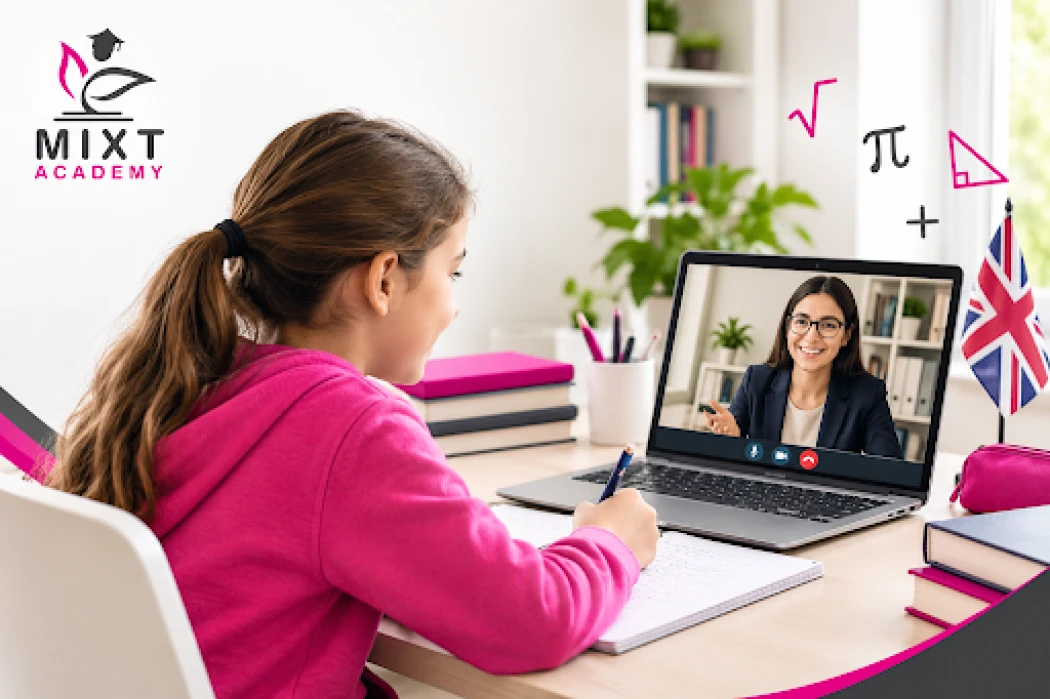
Online Chinese tutoring is a live lesson between a student and a tutor using a video and learning platform. Lessons may be one-to-one or taught in a small group.
Unlike a recorded course, live tuition lets the tutor hear the child’s pronunciation, correct errors, ask follow-up questions and change the activity when the work is too easy or too difficult. A tutor can also adapt examples to the child’s interests, school syllabus or family language background. A balanced lesson may include:
- Listening and spoken conversation
- Pronunciation, tones and sound recognition
- Useful vocabulary and sentence patterns
- Reading Chinese characters
- Handwriting or typed Chinese
- Stories, role-play, games and visual prompts
- Chinese culture and everyday communication
- Exam questions for older students
The balance should change as the child develops. A five-year-old beginner, a bilingual child who speaks Chinese at home and a GCSE student should not receive the same lesson.
Should My Child Learn Mandarin or Cantonese?
Mandarin and Cantonese are spoken forms of Chinese. The best choice depends on why your child is learning.
| Your child’s main goal | Usually the more suitable starting point |
| Preparing for a UK school qualification such as GCSE Chinese | Mandarin, because UK exam courses commonly specify spoken Mandarin |
| Communicating with Mandarin-speaking relatives | Mandarin |
| Communicating with Cantonese-speaking relatives | Cantonese |
| Preparing to live, study or travel in mainland China | Mandarin |
| Maintaining a family connection with Hong Kong or a Cantonese-speaking community | Cantonese may be the more relevant choice. |
| Learning for future study without a family-language preference | Mandarin normally offers the widest range of courses and resources. |

Consult with one of our 1,000+ qualified tutors.
What Is the Difference Between Simplified and Traditional Chinese?
Simplified and traditional Chinese are writing systems, not spoken languages. This difference is easy to miss.
- Simplified Chinese is mainly used in mainland China and Singapore.
- Traditional Chinese is mainly used in Taiwan, Hong Kong and Macau.
- Mandarin can be written with simplified or traditional characters.
- Cantonese learners may use traditional characters, particularly when the family connection is with Hong Kong.
What Should Children Learn in Online Chinese Tuitions?
A strong programme develops communication as well as knowledge. It should not turn into a weekly list of isolated words to memorise.
| Skill | What useful progress looks like |
| Listening | Understanding familiar questions, instructions and short conversations |
| Speaking | Giving relevant answers, asking questions and using clearer pronunciation and tones |
| Reading | Recognising characters in words, sentences and age-appropriate texts |
| Writing | Producing characters and sentences accurately for the child’s level |
| Vocabulary and grammar | Reusing new language in different situations rather than recalling only a word list |
| Cultural understanding | Using language appropriately and understanding the context behind stories, festivals and everyday expressions |
Chinese Tutoring for GCSE and Other Qualifications
An exam-focused online Chinese tutor should know the student’s exact qualification and exam board. For example, the AQA GCSE Chinese (Spoken Mandarin) specification assesses listening, speaking, reading and writing, with each skill contributing 25% of the qualification.
This means that an exam student needs more than general conversation. Lessons may also need to cover responses, reading strategies, translation, character accuracy, timed writing and mark-scheme language. Ask how the tutor will diagnose weak areas and use past-paper work without allowing it to replace real language development.
Is Online Chinese Tutoring Effective for Children?
Yes, live online Chinese lessons can be effective when the child actively uses the language and the private Chinese tutor adapts the teaching to their stage. The format alone does not create progress; lesson quality, regular practice and a suitable tutor matter more. Effective online Chinese tutoring usually has five features:
- The child participates frequently. They answer, ask, describe, repeat, read or write instead of watching the tutor for most of the session.
- Correction is clear. The tutor explains what changed and gives the child another chance to produce the language correctly.
- New material connects to earlier learning. Vocabulary and characters return in later lessons so they move beyond short-term memory.
- Activities suit the child’s age. Visuals, stories and short tasks may work well for younger pupils, while discussion and exam practice may suit teenagers.
- Practice continues between lessons. A few focused minutes on several days is often more useful than one long review immediately before the next class.
Worried About Your Child’s Grades?
Give give them personalised support from qualified UK tutors who make learning easier and more enjoyable.How Long Should an Online Chinese Lesson Be?
There is no perfect duration for every child. These ranges are sensible starting points, not fixed rules:
| Age or stage | Suggested starting length | Useful lesson features |
| Ages 4–6 | 20–30 minutes | Songs, movement, pictures, stories and frequent activity changes |
| Ages 7–11 | 30–45 minutes | Conversation, games, structured vocabulary, reading and short writing tasks |
| Ages 12–16 | 45–60 minutes | Extended speaking, reading, writing, grammar and exam-specific work where needed |
| Older or advanced students | 60 minutes when appropriate | Longer discussion, detailed feedback, complex texts and timed tasks |
If attention drops well before the lesson ends, a shorter, more active session may be better than simply trying to increase screen time.
One-to-One or Group Chinese Lessons?
Both formats can work, but they solve different needs.
| One-to-one lessons | Small-group lessons |
| Teaching moves at one child’s pace. | Students learn alongside peers. |
| More speaking time for the individual | Pair work and group conversation are possible. |
| Easier to target gaps or a specific exam board | A shared course plan keeps the group together. |
| Activities can reflect the child’s interests. | Often offers a more social learning experience |
| Scheduling may be more flexible. | Usually requires a fixed shared timetable |
One-to-one Chinese tutoring is usually the stronger option when a child has a specific target, needs focused correction or learns at a different pace from a class. A small group may suit a child who is at a similar level to the other students.
How Often Should a Child Have Chinese Lessons?
For many beginners, one or two lessons a week is a realistic starting schedule. The child should also practise the language between sessions. Useful five- to ten-minute activities include:
- Reviewing a small set of words or characters
- Listening to a familiar Chinese story or song
- Describing a picture using recent lesson language
- Reading a short text aloud
- Recording and replaying a few sentences
- Having a brief conversation with a Chinese-speaking relative
The aim is regular contact, not extra homework every evening. A tutor should tell parents exactly what to practise and how to do it without teaching incorrect pronunciation or turning family time into another class. Most students also face other subjects harder to learn in UK so they need support like online tutoring from the comfort of home.
How to Choose an Online Chinese Tutor for Your Child
Use the following checks before choosing an online Chinese tutor for your child.
Start With Your Child’s Goal
Write down one main outcome. It might be holding a basic conversation with grandparents, building Mandarin from the beginning, improving character recognition or preparing for a GCSE exam.
2. Check the Tutor
Confirm Mandarin or Cantonese and Simplified or Traditional Chinese. Do not assume that every Chinese tutor teaches every combination.
3. Look for Experience
Fluency does not automatically make someone effective at teaching children. Ask about experience with pupils of your child’s age, complete beginners, heritage speakers or exam students, depending on what you need.
4. Ask How the Tutor Assesses a New Student
The first lessons should establish what the child can understand, say, read and write. For a beginner, the tutor should also learn about interests, attention span and previous exposure to Chinese.
5. Examine the Lesson
Ask how much time the child will spend speaking, what resources will be used and how new language will be reviewed. Strong qualifications matter, but parents also need to know what actually happens during a lesson.
6. Check Progress Reporting
Parents should know how tutors are checked, whether lessons are recorded, who can access recordings, and how concerns are handled. They should also receive clear information about topics covered, progress and next steps.
7. Use a Trial Lesson
A trial lets you see whether the tutor communicates clearly, involves the child and adapts when something is not understood. Ask your child what they learnt and whether they felt able to ask questions.
Older students can also benefit from clear learning goals and, when needed, formal assessments that match their aims. A good tutoring programme should help both parents and students see what they are working toward.
Online Chinese Tutoring With Mixt Academy UK
Mixt Academy’s online Chinese tutors provide live, one-to-one lessons for children and older students in the UK. Teaching can be matched to a learner’s age, current ability and goals, including general Mandarin development, GCSE, A Level, IB and HSK preparation.
Tutors are DBS-checked, and lessons are recorded in the Mixt Portal so students can revisit explanations and parents can follow their learning. Families can start with a free 30-minute session to discuss the child’s needs. You can also review how online tuition works before booking.
Find the Right Starting Point for Your Child
First decide why your child is learning Chinese. Then confirm the spoken language, writing system, lesson format and progress goals that fit that purpose. A good tutor will use those answers to build a clear plan rather than placing every child on the same course.
If you would like help matching your child with a suitable tutor, book a free consultation with Mixt Academy.
We Answer Every Question of Parents
What is the best online Chinese tutoring for kids in the UK?
The best option is live, age-appropriate tuition that matches the child’s chosen language, writing system, current level and goal. Mixt Academy UK has online Chinese tutors with relevant experience, a starting assessment, active speaking practice and measurable progress updates.
Can a complete beginner learn Mandarin online?
Yes, a complete beginner can start with greetings, everyday vocabulary, simple sentence patterns, listening and pronunciation. Characters can be introduced gradually alongside spoken language.
Is Mandarin or Cantonese easier for a child?
Neither is universally easier. Motivation and regular tutoring often matter more than choosing the language that appears simpler. Mandarin is commonly chosen for school and formal study, while Cantonese may be the right choice for communicating with Cantonese-speaking family members.
Should an online Chinese tutor use English in lessons?
English can help a beginner understand instructions or a difficult point. Our Chinese tutor slowly increases the amount of useful Chinese as the child becomes able to follow and respond.
How often should children practise Chinese?
Regular, short contact is usually more manageable than infrequent long study. One or two live lessons a week plus five to ten minutes of focused practice on several other days is a practical starting routine for many families.
How quickly will my child learn Chinese?
There is no reliable fixed timeline. Progress depends on the child’s starting point, age, lesson frequency, practice, goals and exposure outside tuition. Ask the tutor to set short, observable targets instead of promising fluency by a particular date.
Do online Chinese tutors help with GCSE Chinese?
Yes, our tutors know the exact exam board and can teach all assessed skills, not only conversation. They explain how lessons will cover listening, speaking, reading, writing and exam technique.